


Everything Under One Roof
Prestigious and functional headquarters at the Ewald colliery in Herten
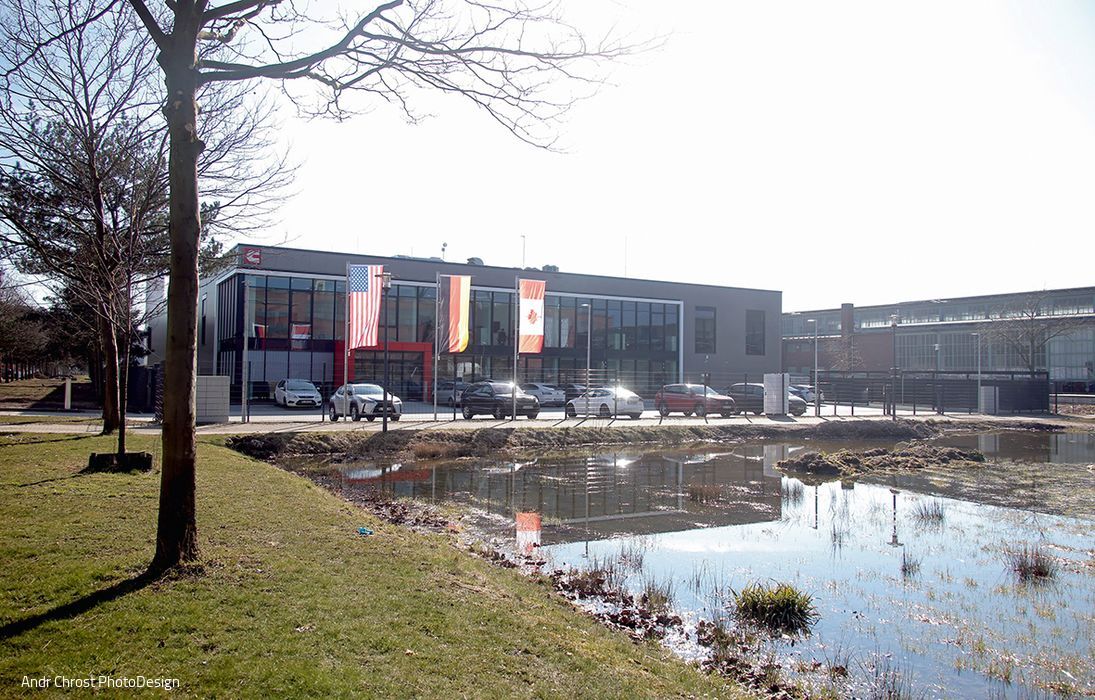


The former Ewald coal mine site in Herten now hosts a cluster of technology-focused companies driving innovation in renewable energy. Cummins, which previously operated a Hydrogenics facility in Gladbeck, relocated its operations here to take advantage of the site's unique potential. The new facility encompasses approximately 4,300 m² of space dedicated to production, research, and administrative functions.
Thieken Architekten und Ingenieure from Dorsten designed the two-aisle hall with its striking, light-filled transparent façade. Project construction specialist Brüninghoff handled the refined structural shell work—encompassing the frame, structural elements, façade, and interior finishing (excluding building services). The nine-metre-high, 80-metre-wide, and 44-metre-deep structure was built as a steel skeleton frame with two distinct zones: an office wing and a single-storey production hall. The hall features two aisles, each spanning 22 metres, housing crane runway systems, slewing cranes, and a reinforced concrete structure in the explosion-proof testing zone. The office wing—clad in flexible lightweight partition walls—occupies two levels and is engineered as a steel frame with reinforced concrete floor slabs. An expansive post-and-beam glass façade floods the offices with natural light, with operable sections supplemented by integrated external roller blinds for glare control. Large window bands similarly bring abundant daylight into the production hall. The remaining exterior envelope is finished in anthracite-coloured sandwich panels.
The building entrance makes a bold architectural statement. Set forward and framed by a striking red accent that echoes the company's corporate identity, it immediately draws the eye. The membrane roof system employs 1.8-millimeter plastic sheets bonded together and mechanically attached to the trapezoidal steel deck, with rainwater managed through a sophisticated negative-pressure drainage system. The building's scale and specialized use demanded a rigorous fire protection strategy: advanced fire detection, smoke and heat management systems, and a sprinkler system work in concert to ensure safety. A particularly notable requirement was the construction of a robust explosion-resistant wall—48 meters long and three meters high—protecting the test facility areas. Remarkably, this complex project was completed in just ten months, a feat made possible through BIM-driven 3D modeling, extensive prefabrication, and seamless coordination across all trades.
Photography:
André Chrost PhotoDesign
ac-photodesign.de
(Published in CUBE Ruhrgebiet 01|23)


A Monumental Challenge Conquered
Comprehensive Renovation and New Living Space in a Heritage-Listed Building

Where Old Meets New
Modern office space has emerged within a historic Essen landmark.
Hand-Crafted Originals
Clemens Frantzen: Bespoke Furniture Design

A Garage for "Theo"
The airship hangar—equally at home as event venue or architectural statement—sets the standard for sustainable design.