


Multi-generational living
Planning, experiences, expert insights
Christoph Gunßer: Mr Post, you are considered a pioneer in the design of multi-generational housing. Is demand for this type of housing increasing?
Norbert Post: Definitely yes, if I measure it solely by the enquiries we receive from groups and local authorities with very specific tenders. That didn't happen in the past. Our first projects have been occupied for 17 years, and it took seven years of discussion to get to grips with the issue. Today, we are much further along: local authorities know that they need building communities to realise multi-generational housing. Often, there are already fixed quotas of municipal land that are allocated to housing projects. Many people are looking for forms of housing that promote multi-generational neighbourhoods.
In 2016, you estimated the market segment of interested parties at five per cent in DAB. Is the greatest demand still among single women?
Locally, I now see the demand at around ten to 15 per cent, and we now have many young families, a generation with experience of shared flats, who are initiating projects. A second group are people who are looking for inclusive living.
Many people have a romanticised view of multi-generational living: happy grannies look after the children for free, while their parents do their shopping for them. Everyone has more time and social contacts. How close is this idealised image to reality?
A housing project is an exploration of diversity. The enrichment lies in not separating the generations, but in experiencing them with their different needs and lifestyles. Of course, these small acts of assistance also happen individually. But it's not like Bullerbü; everyone has to work at it. It's already a big step for an urban housing project when the generations regularly notice each other again and remain in dialogue.
What needs to be taken into account during planning to ensure that it works? Is there a type of toolkit for building typology that works particularly well?
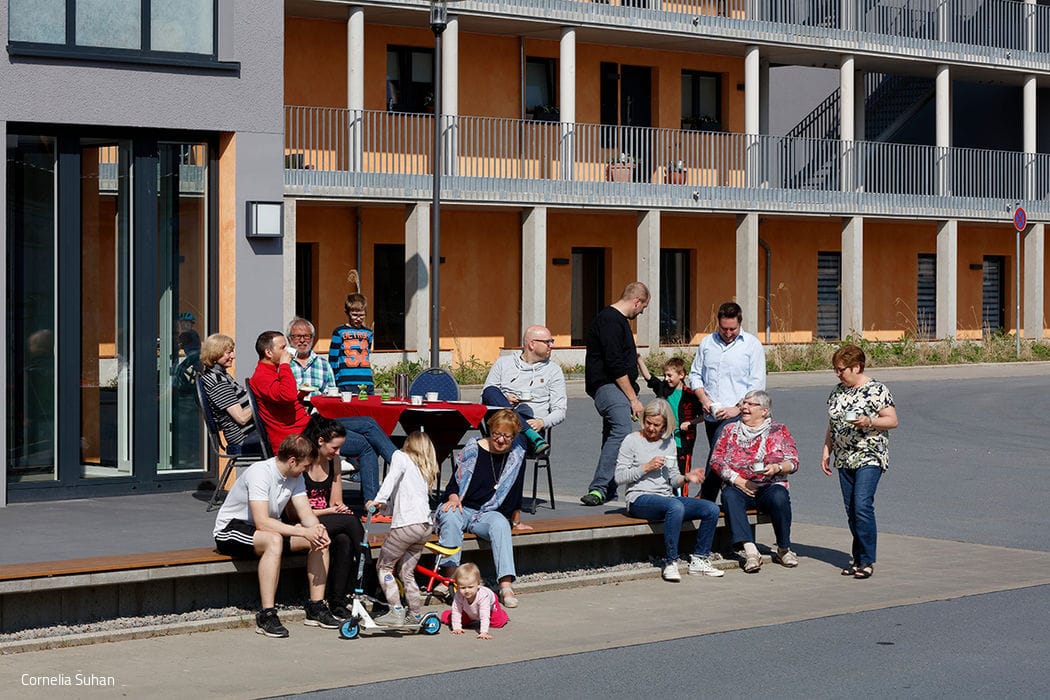
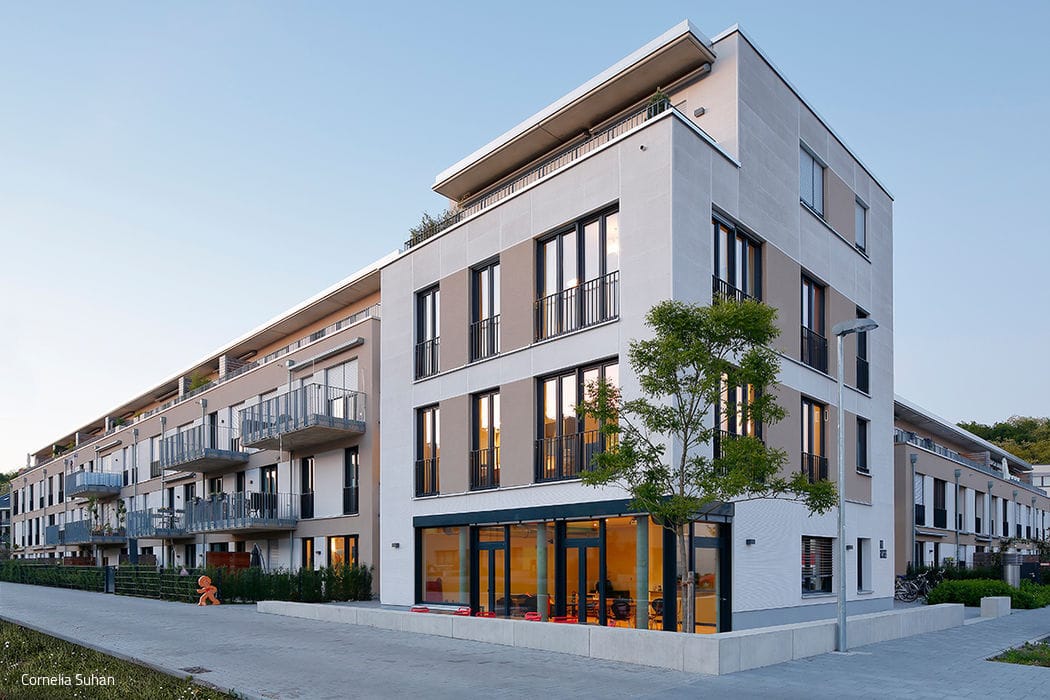
The space between the flats is our toolbox. In residential construction, everything revolves around efficiency, seriality and returns. We, on the other hand, work for a group of developers who want to create their own living space. Our aim is to turn the access route from the street to the flat into a communal area, an extension of the flat with play areas for children, flower beds for adults and benches for the elderly – everything that a traditional village street used to offer. This can be implemented at the level of the flat, the house and the neighbourhood. One of our guiding principles is that housing is the stage for life. You shouldn't have to walk through a "dark tube" to get to your flat – that's the battery cage model.
On a symbolic level: what is appropriate as a building design, as an image, for an open, multi-option society? If you could influence the development plan, what would you prefer?
The courtyard, the monastery! Our residents sometimes see the projects as being laid out like a monastery: there is the lift as a campanile, the common room as the refectory, the gallery access as the cloister. The courtyard and room layout is a very important symbol. We regularly influence development planning in this regard. Classic urban planning starts with anonymous builders and ends up with serial types. That's why cooperation in urban planning is essential for group projects.
Does this rub off on other investors?
Building communities are the nucleus of new forms of living, such as mixed-generation housing concepts. More and more housing associations are learning that this is also good for them. Even very conventional property developers are interested in getting a building community as a driving force in their neighbourhood, because it spreads a good image and gets a lot of publicity, even years before construction begins. I don't know of any property developers who reject our building designs. On the contrary, more and more traditional housing cooperatives are trying to plan and build for tenant building associations, such as the Alter Steinbruch project in Herdecke.
You specialise in new forms of living. How did that come about?
I am part of a generation that strongly criticised the large housing estates of the 1970s while still at university. After graduating, we were fortunate that for years, even decades, there was no great need for housing construction, allowing us to concentrate on small, high-quality projects. I myself grew up in a small housing estate, part of which was built in the 1950s through organised self-help. In return for a public building loan, each homeowner helped to build a rental flat. It was an intense neighbourhood with a wide variety of people. Perhaps that is why, in all my housing designs, I have been particularly interested in creating building and living forms that have a positive influence on people's behaviour towards one another.
What role do your personal interests play in this?
I myself had been searching for a community-building form of living for a long time, which is probably why I often met people who were thinking about the same thing. The breakthrough came about 20 years ago with a group of people who, after several years of internal discussion, were looking for a form of living on an inner-city plot of land where young and older people could live in a balanced tension between individuality and community, closeness and distance.
Where you constantly deal with such diverse forms of living: How do you yourself live and reside?
I live in Cologne in a mixed-use, largely car-free neighbourhood, surrounded by five building communities and myself in a building community with 17 parties with people between the ages of five and 75. We have reduced the private areas to such an extent that shared facilities, such as a garden courtyard, a roof terrace, a guest apartment and a ground-level communal and multi-purpose room, are available to everyone. However, for me and for our office, we do not provide services for the group from within the group. That leads to conflicts. It's also too stressful for me to be the client, planner and neighbour. That's why, with a heavy heart, I didn't plan my own housing project myself. That's the biggest challenge for an architect.
Is your group also suitable for older people?
I hope to grow old in my job, in the office. I think it's fundamentally wrong to plan a housing project solely for old age. A communal project should not be started when you think you need it to survive or to get help, but when you still have something to contribute to the group and can get used to each other in normal circumstances. Only those who fill a housing project with life and appreciate it in their younger years can grow old there with peace of mind.
When it comes to assembly projects like this, some people think of endless meetings, lots of coordination and long construction times. Is it financially worthwhile for the architects involved?
These are certainly not the most economical projects. They involve a lot of effort. It's a question of what you expect from your job: whether it should be particularly efficient or whether it should satisfy you. The nice thing about it is that you can define the objectives of your own construction project together with the building owners and residents themselves.
How do the projects come to you?
Groups have become much more self-confident. If they are well moderated and want to get the most out of a plot of land, they invite three or more architects to submit proposals. Nowadays, there is so much information available about building communities and examples to look at that groups are very confident in their role as developers. However, many projects would not exist without an architect taking the initiative. For example, we are currently working on the conversion of a former police administration building in Dortmund. No building group can apply for something like this within the set time frame because they first have to get organised. I had known the building for a long time and bought it at auction for a young cooperative, then discussed and decided with a group on its shared use for families, couples and singles in all its breadth and countless variations.
Have you tried something similar for local entrepreneurs in commercial construction?
We developed a construction and operating concept for the conversion of a warehouse at Dortmund harbour. Commercial buildings are generally considered boring and bland. They turn half of the city into wastelands. Everyone was excited by the idea of how different people could work together there. Ultimately, however, the property office awarded the contract to an investor because they did not trust a cooperative to do the job. That's how we started out in the housing sector. Everyone had reservations at first. And today, in a city where there are a few building communities, no land seller or authority has any reservations, and there are enough banks that know this is a very good model and not a higher risk at all – quite the contrary.
What skills have you acquired over the years through these projects?
To view the role of the architect as more than just that of an artist, to establish a level playing field between residents, builders and planners, without compromising on design standards. For the traditional graduate, housing is simple, "anyone can do it". We are increasingly realising how complex housing is: good housing construction is more complex than hospital construction. A great deal of emotion comes into play. This requires users who do not necessarily have any prior training, who are self-aware and interested. This teamwork does not underestimate anyone.
Is there brand building in joint projects?
I think group projects should be recognised. Our projects are recognisable. The way forward is to have this toolbox, but to develop something with the group that suits this place, this group, and reflects their self-image.
What are the pitfalls here?
In a project like this, everyone wants to see themselves reflected in it. The particularly difficult thing is to strike a balance between individualisation and community. That can ruin a project. What are the criteria for good living? That's why we never do architecture and moderation from a single source. The architect is not the mediator in every detail, but also a party. That requires a neutral translator.
Do you encounter issues with the formation of parallel societies in your projects?
The difference is very noticeable. However, one group reaches a basic consensus relatively quickly. Tolerance grows in such groups, even if you have lived in a small social bubble. I have witnessed some amazing learning processes there. It is a democratisation process that radiates outwards.
Is there an optimal group size?
Twenty to thirty flats are enough to form interest groups as subgroups, but also to integrate loners.
What do you think of cluster flats, which group together lots of relatively small flats to form shared accommodation?
That's exactly what we're working on now. And there's a practical benefit to this approach: the real power of communal living lies in identifying which spaces can be meaningfully shared. It's remarkable how social and comfortable shared living can actually be. As we like to say, luxury is in the sharing. If we want to build smarter—not just cheaper—we need to rethink how much individual space we really need. Many people assume a certain square footage is essential for happiness. Yet when they see our completed projects, they're often surprised at how spacious the apartments feel, thanks to all the shared areas around them.
Interview by Christoph Gunßer
Norbert Post
Norbert Post is founder and managing director of post welters + partner mbB Architekten & Stadtplaner BDA/SRL Dortmund. Over the past 25 years, he and his team have specialized in developing and realizing collaborative housing and construction projects, advising cities on innovative residential models, and he himself lives in a building cooperative.
Since 2016, as chairman of the Bundesverband Baugemeinschaften e. V. (Federal Association of Building Communities), he has championed the cause of collaborative construction practices.
Multi-generational living is a growing trend. But what considerations are critical when designing such communal housing projects? Dortmund-based architect and urban planner Norbert Post has made this his specialty. In this conversation with Christoph Gunßer, he explores the significance of in-between spaces, monastic design principles, and moving beyond the idyllic village ideal.
(Published in CUBE Ruhrgebiet 02|20)


Innovative and Atmospheric
Healthcare Design for Tomorrow—Built with Sustainable Hybrid Timber Construction
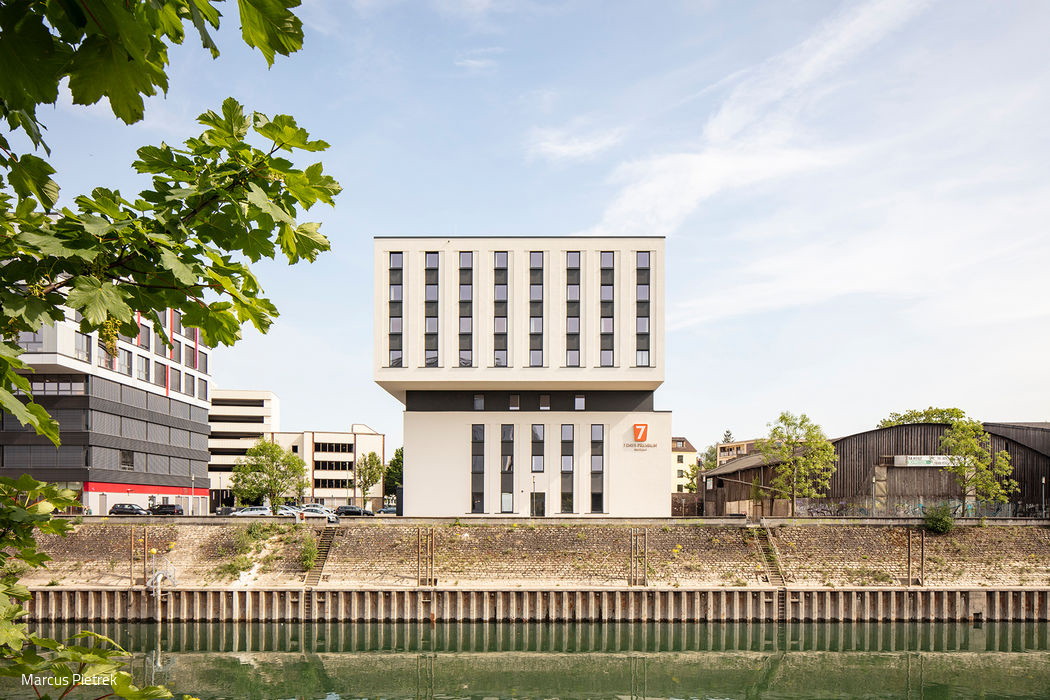
Hotel with harbor character
Duisburg's inner harbour has a bold new landmark

The Entryway to the City
An apartment building in Herne that commands its context as a singular architectural statement.
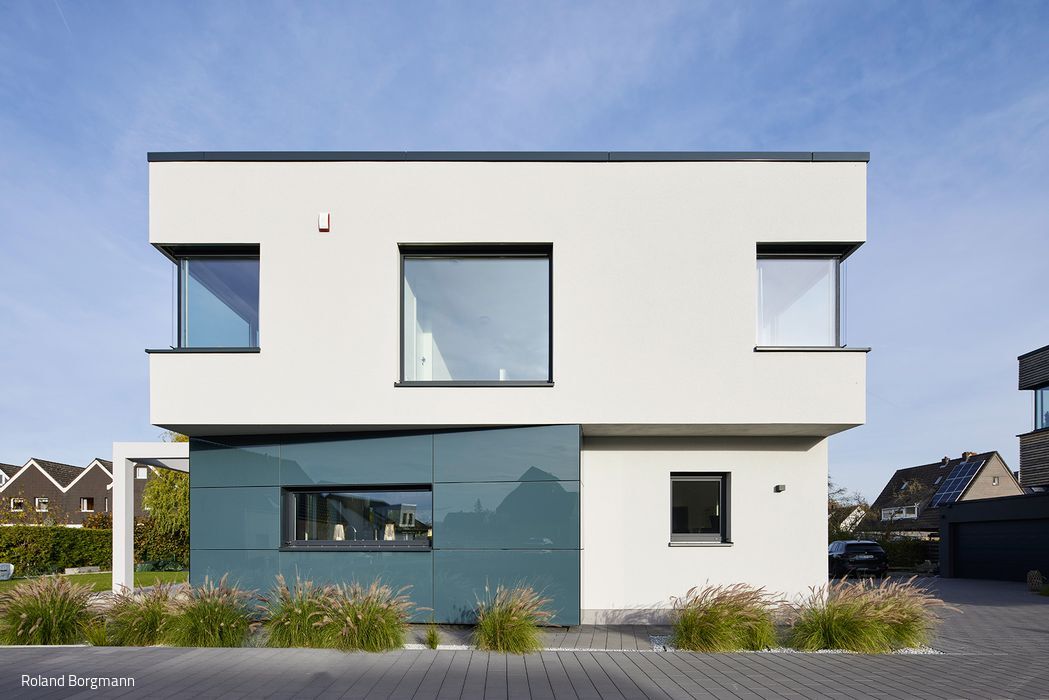
Pure Living
An energy-autonomous family home that captivates through open living and intelligent spatial design.