


Less Is More
Vierlinden-Höfe in Duisburg: A Model Climate-Neutral Housing Estate
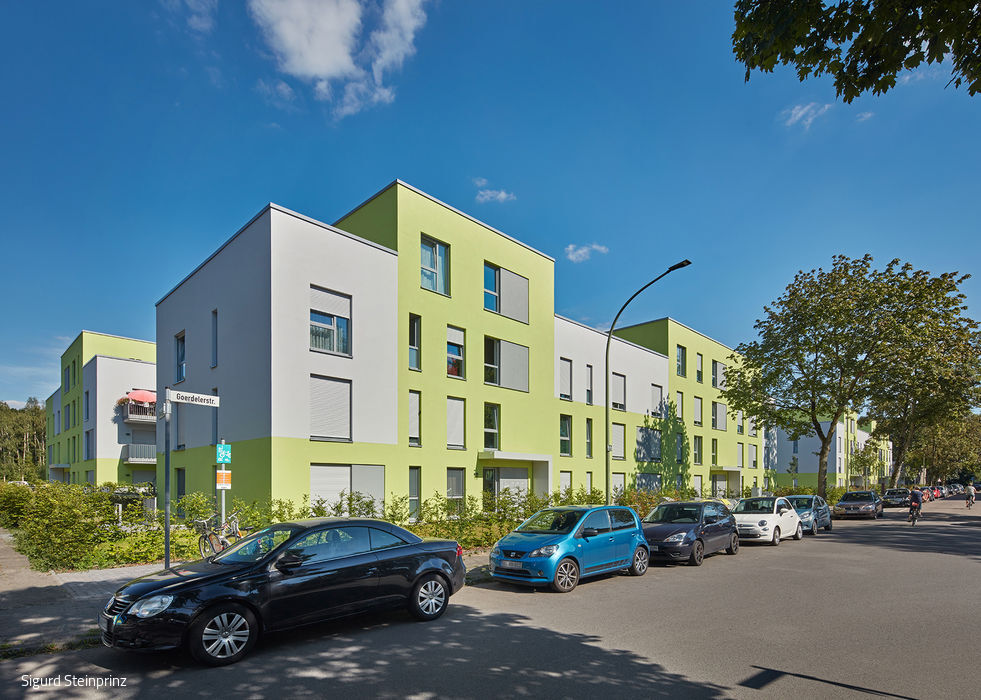


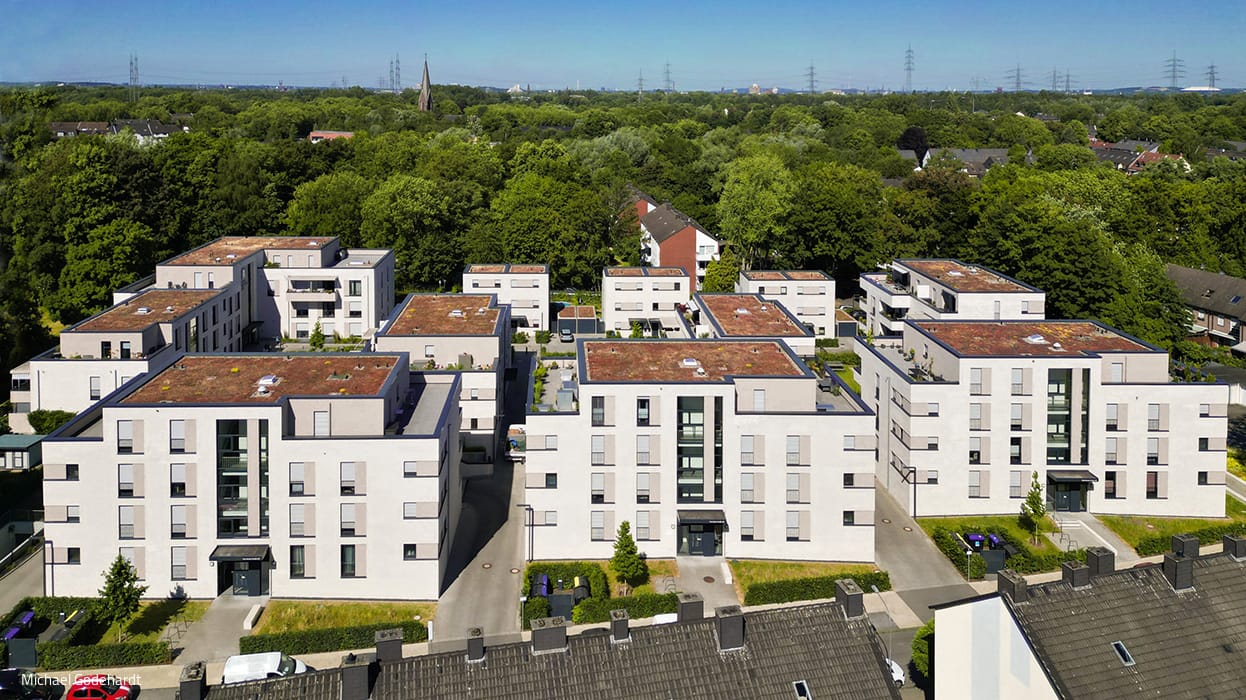
Commissioned by Gebag Duisburg, the municipal housing association, a neighbourhood of 98 apartments has risen on the grounds of a former school in northern Duisburg. Henning Shin Architects from Düsseldorf faced a demanding brief: design an energy-efficient building without inflating costs, so that publicly subsidised housing could be offered at accessible rates. "That's why the principle of 'less is more' wasn't simply a design philosophy," explains architect Richard Henning, "it was fundamental to achieving our goal: excellent architecture, thoughtful urban design—all energy-efficient and genuinely affordable." The result is Vierlinden-Höfe, which forms part of North Rhine-Westphalia's state-wide initiative "100 Climate-Neutral Housing Estates."
With no distinctive landmarks in the surrounding area to anchor the neighbourhood's identity, Henning Shin Architects chose an open perimeter block layout. This approach delivers generous spatial quality while keeping the cubic, stripped-down building forms highly efficient and economical. Despite their disciplined approach to budgeting, the architects invested in carefully crafted details that elevate the design. The colour palette—a warm light green and soft grey—creates striking visual cohesion and gives the neighbourhood a distinctive character. Standardisation was paramount in planning: matching stairwell cores and balcony modules reduced both construction timelines and error risks during a period of escalating costs. Every apartment opens onto the shared, landscaped courtyards. The three- and four-bedroom units feature flowing floor plans with living rooms consistently oriented toward the courtyard. Penthouse units enjoy generous roof terraces. The open design and full-height windows flood interiors with natural light. Accessibility extends across the entire neighbourhood—from individual apartments to waste disposal areas designed for barrier-free sorting. Built to the three-litre house standard, these solid concrete and sand-lime brick structures boast excellent thermal mass. Combined with premium insulation, this approach embodies true low-energy design principles. The neighbourhood draws heat from a district heating network and generates electricity through photovoltaics. Car-sharing facilities, EV charging stations, and a bicycle library round out the sustainable mobility strategy.
Photography Credits:
Sigurd Steinprinz
www.steinprinz.de
(Published in CUBE Ruhrgebiet 03|22)



House and garden from a single source
Mastering restraint: achieving impact through simplicity
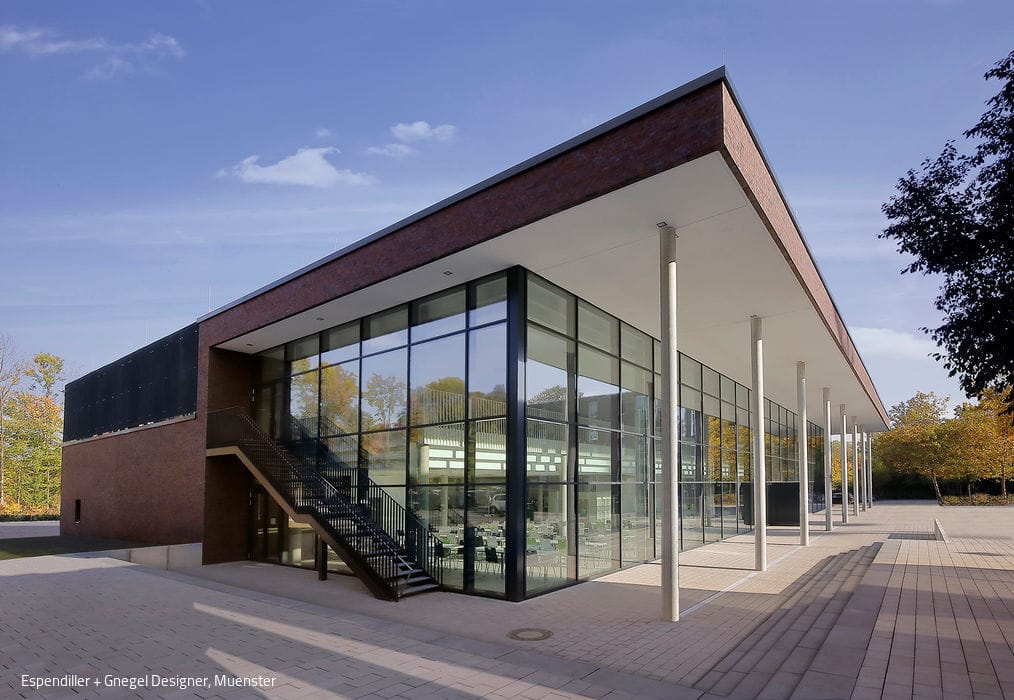
Striking Contrasts
At Nordkirchen's University of Applied Sciences for Finance, history and contemporary design converge
Rooted in the Region
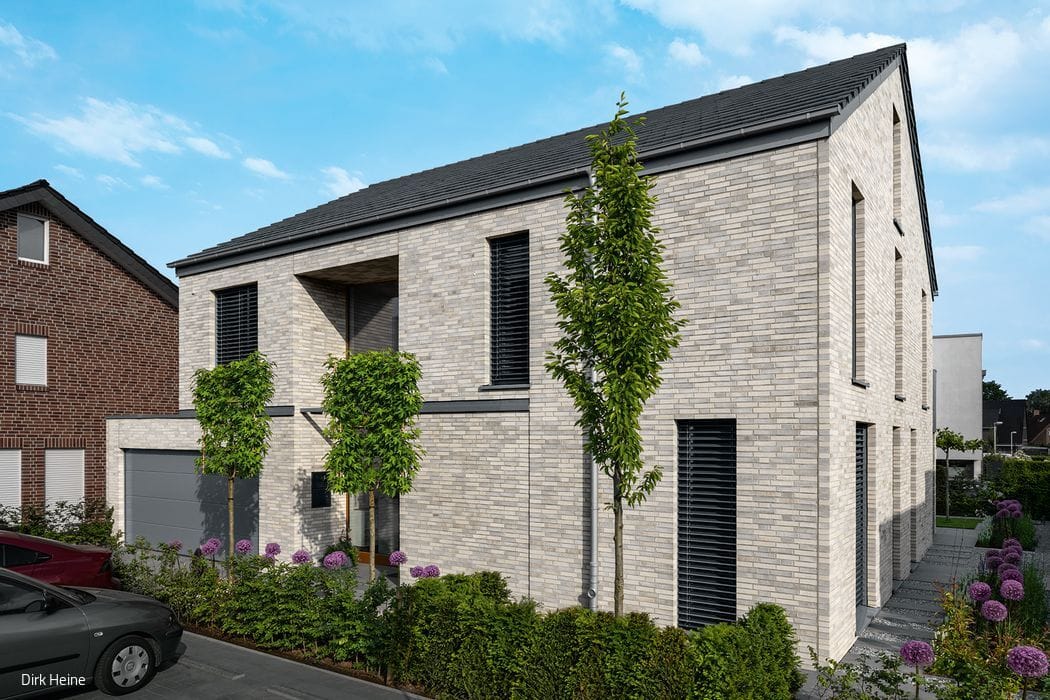
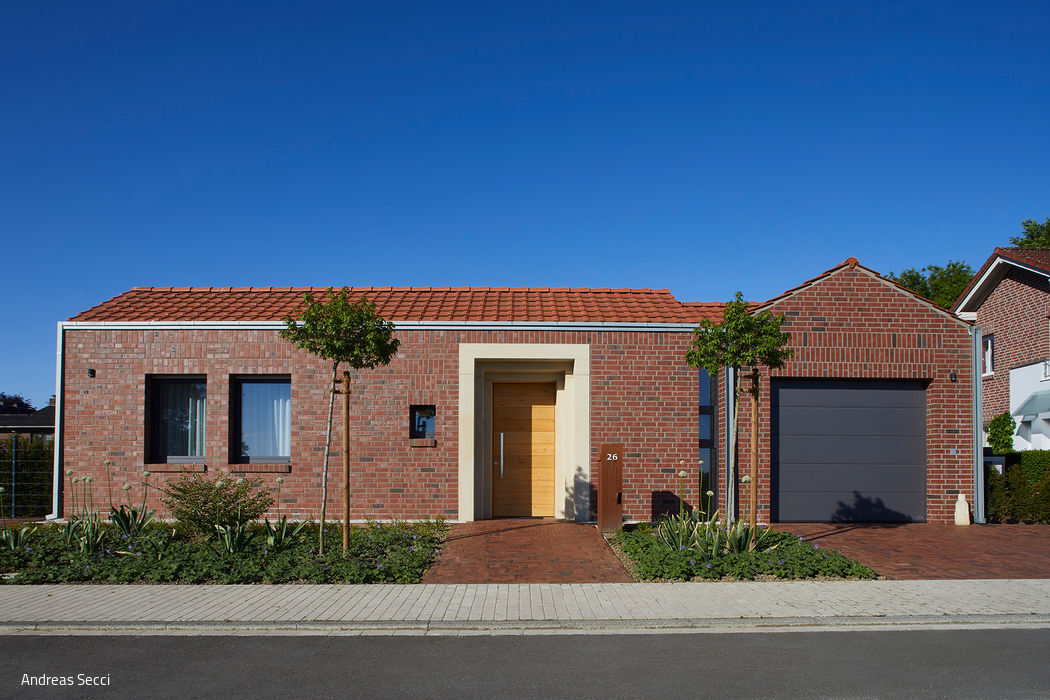
A Clinker Brick Villa with Refined Modern Restraint
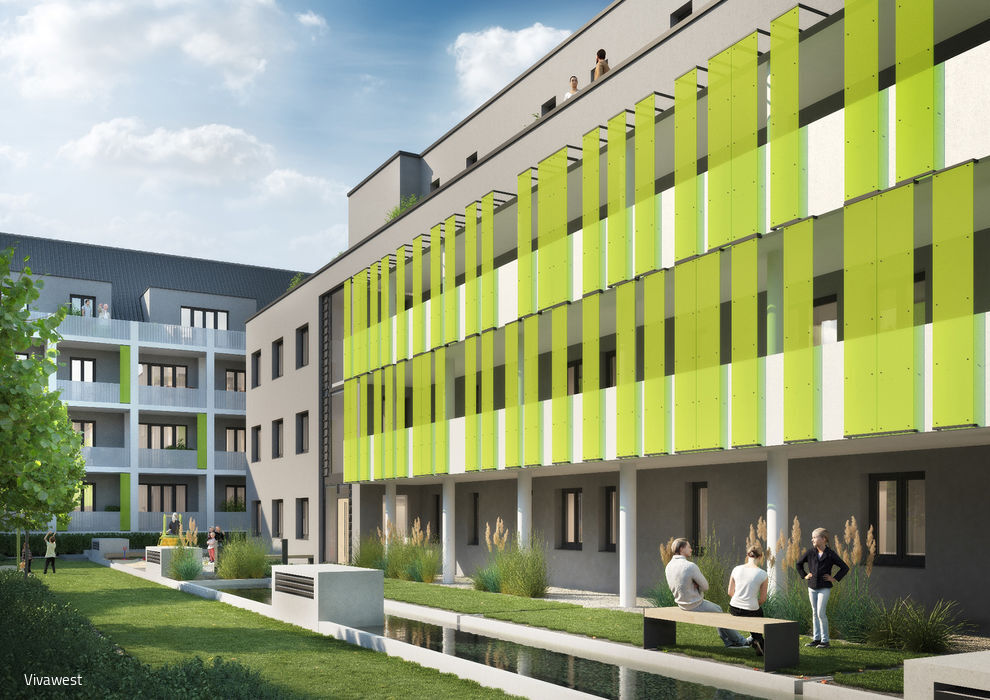
Green Living Haven in Rüttenscheid
The location's proximity to Essen's green heart—the Grugapark—and to Rüttenscheider Straße makes it particularly compelling.