


History Reimagined
The State Archaeological Collection Shines in New Splendor
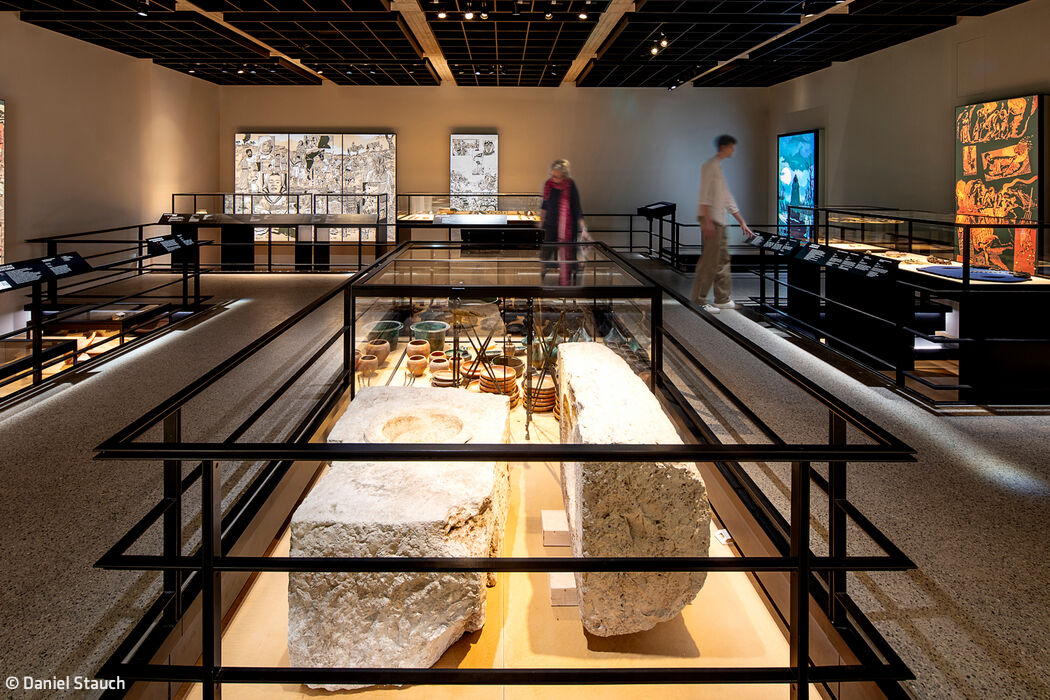


Bavaria's State Archaeological Collection has recently undergone a remarkable transformation. The striking Corten steel structure (designed by von Werz, Ottow, Bachmann and Marx) – a landmark since 1976 – has been comprehensively renovated by Nieto Sobejano Arquitectos and expanded with dedicated space for special exhibitions and an inviting roof terrace. The interior has been equally reimagined: Stuttgart's Atelier Brückner has orchestrated an entirely new permanent exhibition, bringing exceptional archaeological treasures from Bavaria's past to life.
Located at Lerchenfeldstraße 2 in Lehel, the State Archaeological Collection functions as both repository and public museum. Its team preserves and researches archaeological discoveries unearthed across Bavaria, while the museum itself acts as a gateway to this wealth of knowledge. Atelier Brückner faced an ambitious brief: staging 15,000 exceptional pieces spanning the collection's scope. Since 1997, this Stuttgart-based studio of 130 specialists has crafted narrative environments for museums and cultural institutions worldwide. For Munich, they devised a distinctive curatorial strategy: allowing objects from all departments of Bavarian archaeology to speak in dialogue with one another. Spanning prehistory through the modern era, from Mediterranean civilizations to the Near East, and encompassing numismatic treasures, these objects become the focal point within boldly articulated spatial compositions. The exhibition unfolds in two parts: the first explores archaeology's essential methodologies and principles; the second presents the collection itself. A square grid—derived from the building's own architectural language—establishes the unifying design principle across all galleries, evident in both the floor plan and ceiling structure. From this framework, distinct rooms and spatial experiences emerge, separated by luminous gaps and light-filled atriums that showcase monumental pieces: a Roman mosaic and a fountain mechanism from Munich's historic Marienhof. An artistic installation in the stairwell serves as prologue and epilogue, featuring cascading archaeological concepts projected as layered fragments—power, dominion, values, and belief—drawing a parallel to the strata of excavation itself. The stairwell provides final access to the roof terrace. Through restrained, intentional design choices, Brückner has created varied, atmospheric spaces that transform the sequence of galleries into a compelling journey where architecture and exhibition design merge into a unified experience.
www.atelier-brueckner.com
www.archaeologie.bayern
Photography:
Daniel Stauch
www.danielstauch.com
(Featured in CUBE Munich 02|24)

From Monastery to Clinic
Transforming a Friedrich von Gärtner Landmark

Learning in distinguished surroundings
Expanding the Fresenius Campus: Two New Pavilions
Blending Old and New
The ground floor of a Laim villa transformed into an entirely new spatial experience.
Primary school built around a learning house concept
Inclusive, Flexible, and Architecturally Responsive