


Restrained
A compact new building creates improved learning conditions for future physicians
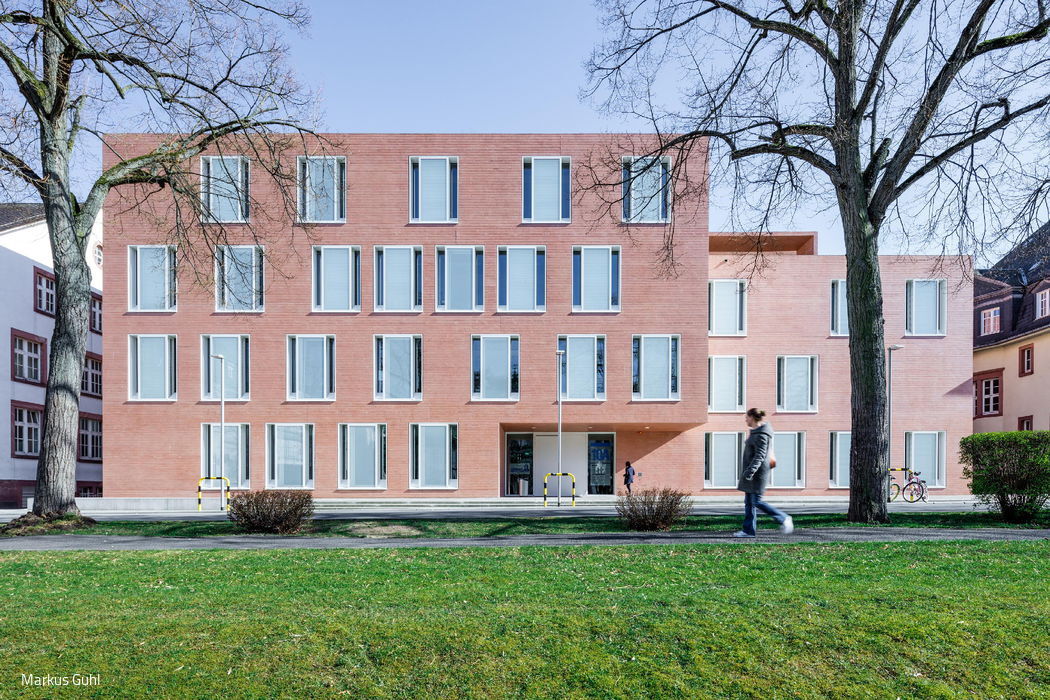


To enhance the conditions for medical study in Frankfurt, the project went beyond constructing a large lecture hall—it also created the Medicum, complete with an examination hall and practice rooms where aspiring physicians can deepen their knowledge and apply it in practice. Stuttgart-based Wulf Architekten designed the new building on the university hospital campus in close proximity to the Main River. The Medicum's setting is characterized by historic neighboring structures and the Rose Garden on its northern edge. To the south, green spaces of the surrounding buildings create a natural transition.
The architects successfully accommodated an extensive program of spaces within the constrained site, while thoughtfully incorporating the historic buildings adjacent to the Rose Garden. The guiding design principle was clear: the new building should integrate sensitively into the existing context with notable restraint. Two cubes of differing heights form a unified structure that aligns with its surroundings in both height and articulation. The offset facade facing the Rose Garden creates a distinctly recognizable entrance. Upon entering the Medicum, visitors encounter a shared foyer situated between the two cubic volumes. Here, a central staircase rises to the upper floors, serving as the building's organizational heart.
By varying the building height from four to three stories and adjusting the building depth from three to two structural bays, each functional area is clearly and distinctly organized on a single level: The examination hall in the basement of the two-bay section accommodates approximately 200 people and opens onto a generous sunken courtyard. Seminar rooms are located on the ground floor, while teaching, learning, and administration spaces occupy the upper floors. The dean's suite, positioned on the top floor, forms an autonomous zone with its own conference rooms. The central staircase, positioned at the junction between the two cubes, reinforces intuitive wayfinding throughout the building.
The building is designed as a flexibly usable reinforced concrete structure whose ceilings and walls offer substantial thermal mass potential. The highly compact, energy-efficient building form derives its character from a minimized façade surface featuring punched windows and an external shell of prefabricated concrete elements. Its reddish-brown glazed fair-faced concrete was executed as monolithic in-situ concrete with timber shuttering. The material expression and color palette of the Medicum correspond with the red sandstone façade elements of the adjacent historic, listed buildings, such as the library directly to the west.
Photography Credits:
Markus Guhl for wulf architekten
www.architekturfotograf-markus-guhl.com
(Published in CUBE Frankfurt 03|21)
Im Geist Des Ortes
Behutsame Sanierung der Nord-Ost-Kirche schafft neue Präsenz und moderne Standards
All pulling together
Smart Design, Lower Costs, Better Living: The Case for Flexibility
Living in Flow
Germany's First High-Rise to Unite Work, Living, and Public Space
A Home in Four Volumes
A Spacious Villa with an Unconventional Floor Plan—and Not a Right Angle in Sight