


Hideouts in the Vulkaneifel
Two holiday homes are situated together in the tranquillity of nature.
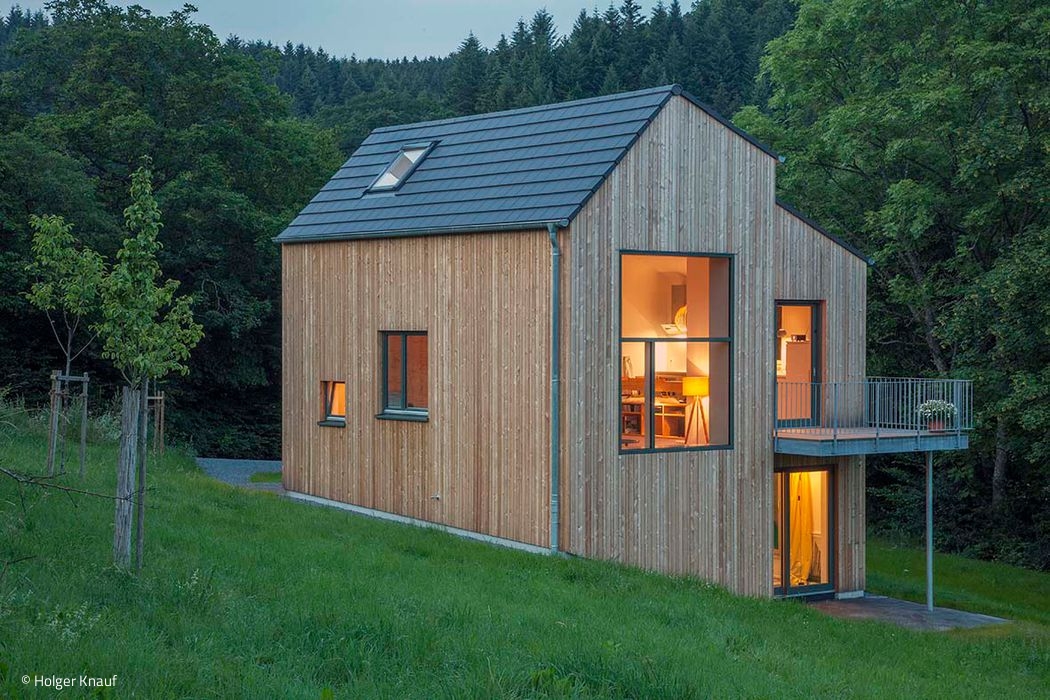

Enjoy the silence, recharge your batteries, experience nature's cinema. The Vulkaneifel, with its deep valleys, extensive forests, volcanic domes and crater lakes, hides many gems that it gladly reveals to those seeking relaxation. Time flies by, a short trip turns into an extended stay, and you don't want to leave. It's good to have the right accommodation ready and waiting. A place where you feel comfortable as soon as you walk in, where you can immediately feel yourself relaxing.
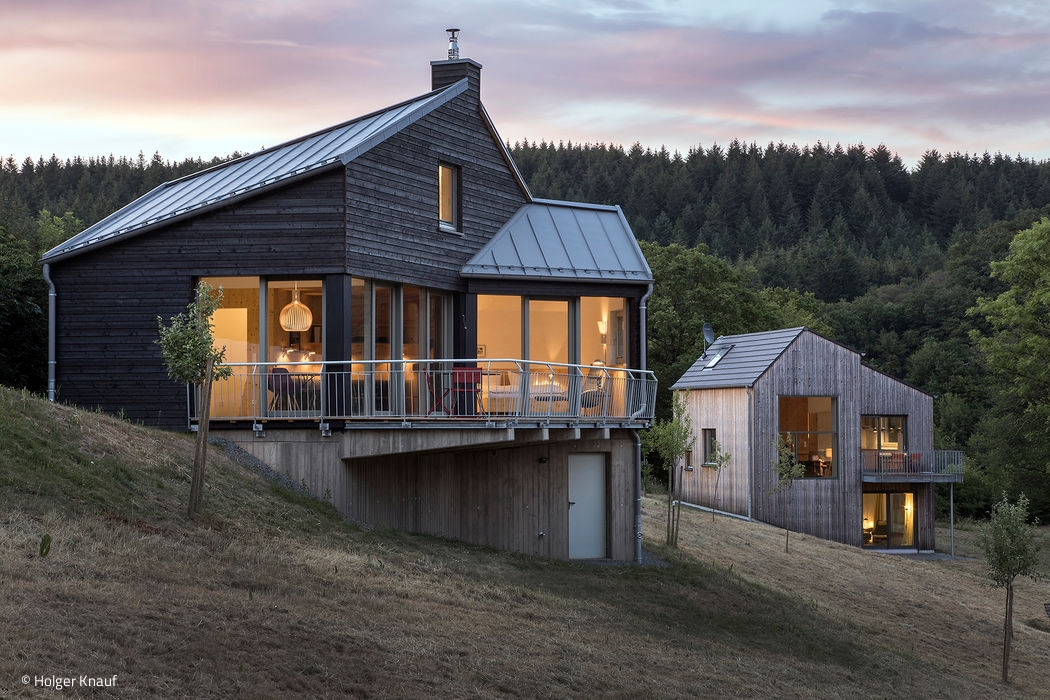
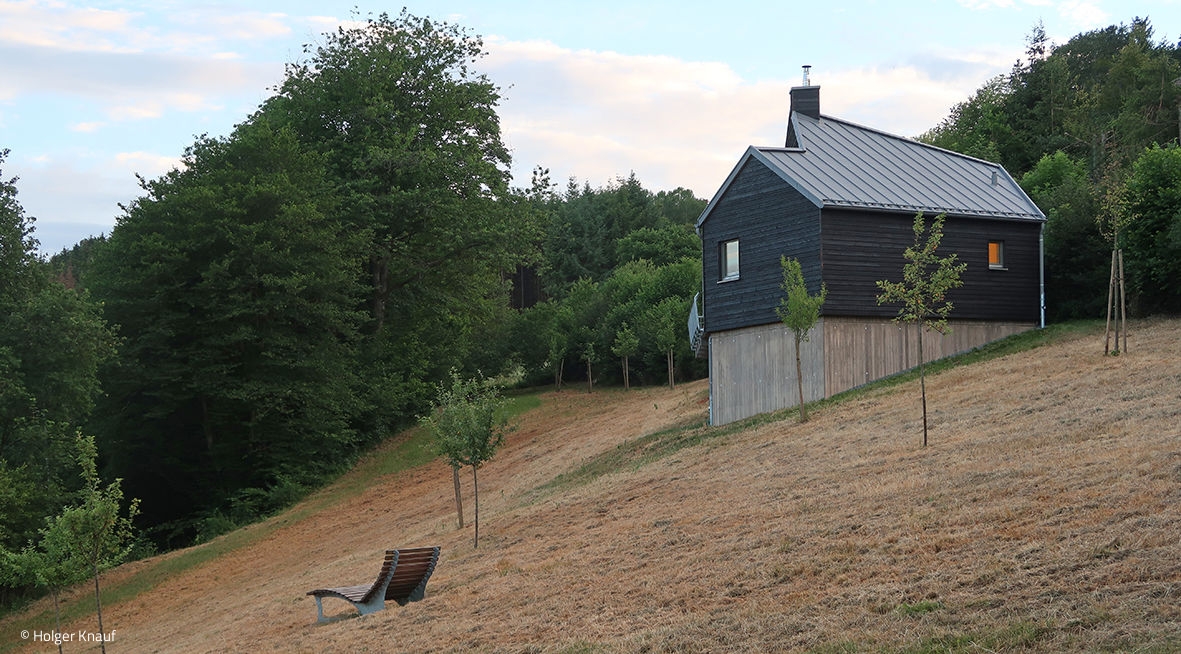
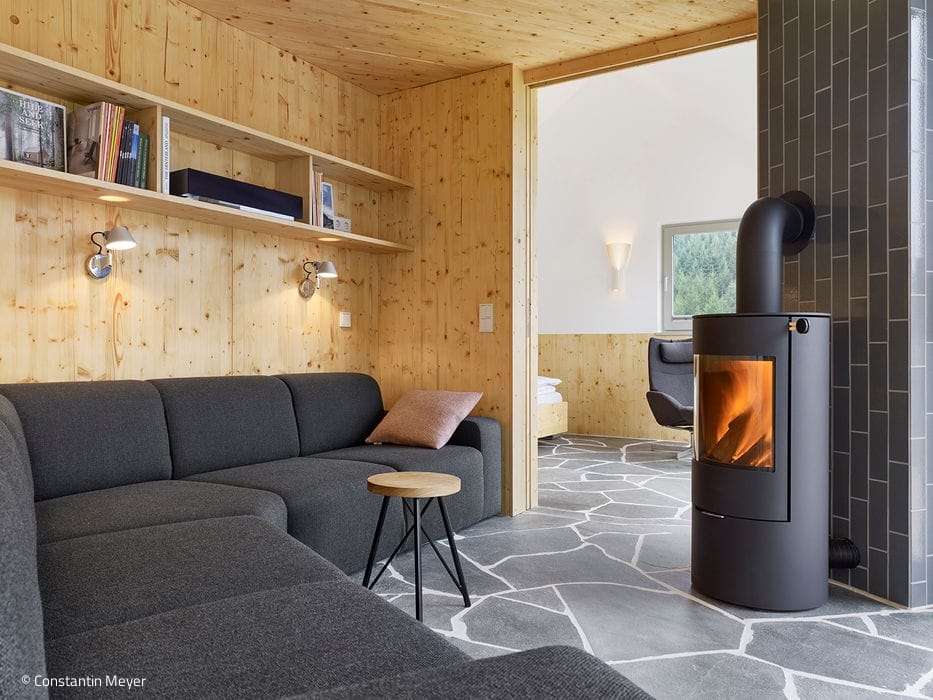
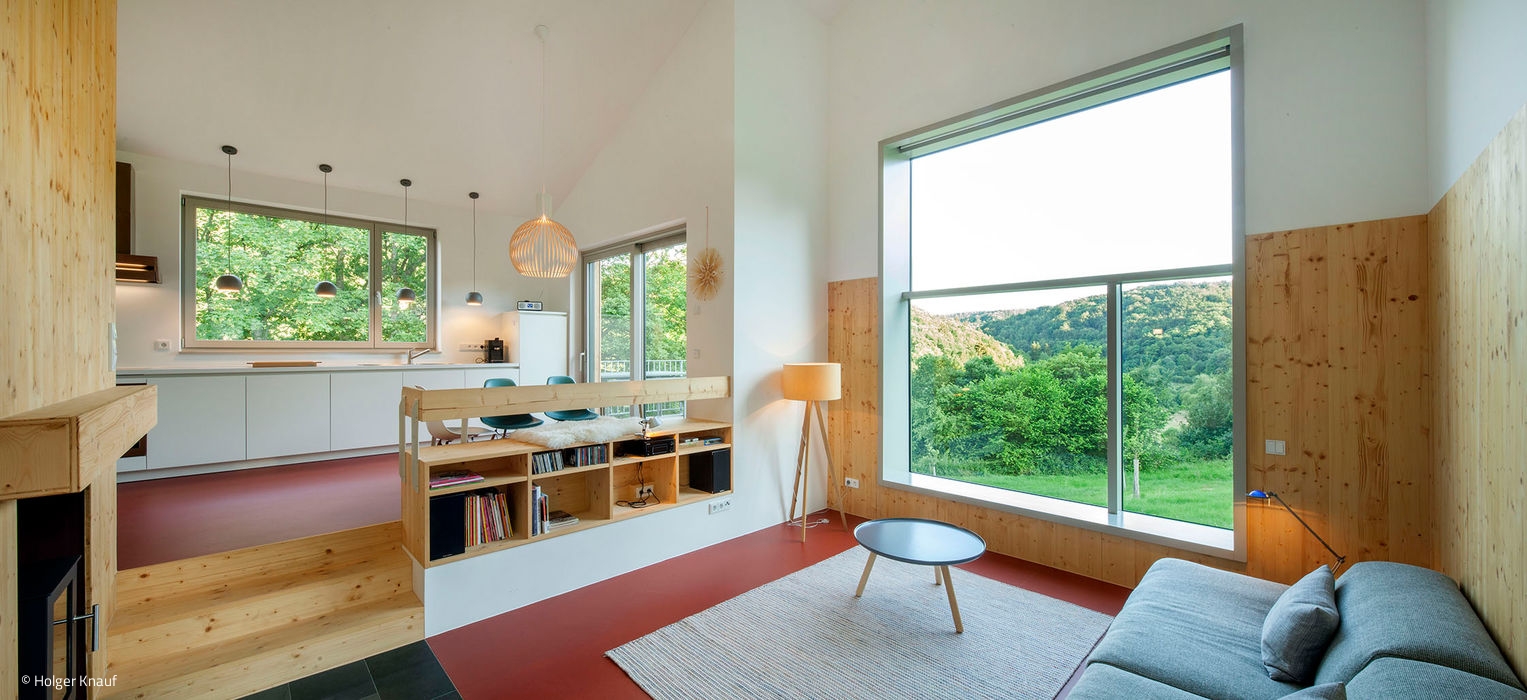
Such a residence is located on a steep, south-facing, 4,000 m² orchard meadow. Strictly speaking, there are actually two. The smaller of the two, clad in black carbonised wood like a barn, stands on a concrete base at the top of the slope. It shields itself from the world and the larger house below with its façade, which is almost closed on two sides. The house opens up towards the valley, the roof rises and forms a spacious, high gable. A floor-to-ceiling window runs along the entire south-western side, offering spectacular views of the Little Kyll Valley at any time of day or year. The 55 m² interior has a polygonal floor plan and appears considerably larger than the square footage alone would suggest. The greenish shimmering flooring made of rough-split quartzite looks both elegant and raw. The open sequence of rooms, which are divided by the ceiling height, creates a sense of space. The kitchen and dining area opens up to the gallery, while the cave-like low-ceilinged living room corner exudes cosiness. The bedroom, which is open to the ridge, can be separated by a sliding door like a small house of its own, promising seclusion and intimacy when needed. The small Vulkaneifelhaus can accommodate a maximum of two people, while the large house, at 106 m², is almost twice as large and can accommodate up to six guests.
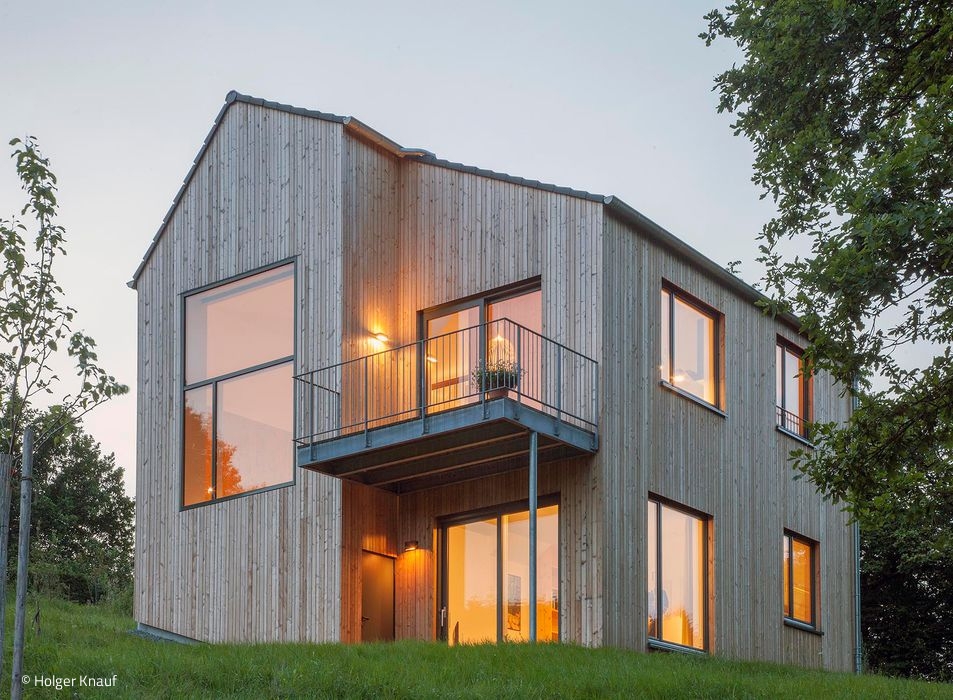
In the case of the larger building, architects Fiederling Habersang cleverly utilised the topography of the site and arranged the rooms on different levels to follow the sloping terrain. There are seven rooms in total, grouped in a spiral around a central core with a fireplace. Sometimes the rooms share the airspace, sometimes they are separated by narrow passageways. This creates an alternation between communal areas and places of retreat. Visual connections within the house and to the outside space arise as if by chance, yet stage the location very deliberately. This is also achieved through the harmonious choice of materials, with lots of wood and large glass surfaces. Nature gently pushes its way into the consciousness and exudes relaxation unnoticed. Just as it should be.
Photography Credits:
Holger Knauf
www.holgerknauf.de
Constantin Meyer
www.constantin-meyer.de
(Published in CUBE Cologne Bonn 02|20)


Simplicity as Principle
A warehouse and production facility that speaks through honest structure and straightforward design
A Balanced Collaboration
The Forum at Deutzer Dom: Urban Gathering Spaces, Inside and Out
Chromatic Harmonies in Art
In this art collector's villa, rooms and artworks engage in an elegant dialogue
Bold Design Meets Sustainability
Bold Colour and Purpose: Inside the Clouth Quarter's Design-Forward Hotel