


Measured Confidence
The new school building and the heritage-listed historic structure form a harmonious whole


SBH Schulbau Hamburg, a state-owned enterprise, oversees the construction and management of approximately 3,000 school buildings across the city. Nettelnburg, an open all-day school in the Fiddigshagen area of Bergedorf, was recently expanded by BKSA Hamburg—a joint venture between BKS Architekten and the assmann group. The expansion project encompassed a new school building with administrative facilities and a dual-court sports hall, along with comprehensive renovation of existing communal spaces and classrooms. The campus comprises structures of varying ages, construction methods, and typologies, with the heritage-protected main building from 1928 serving as the architectural centerpiece.
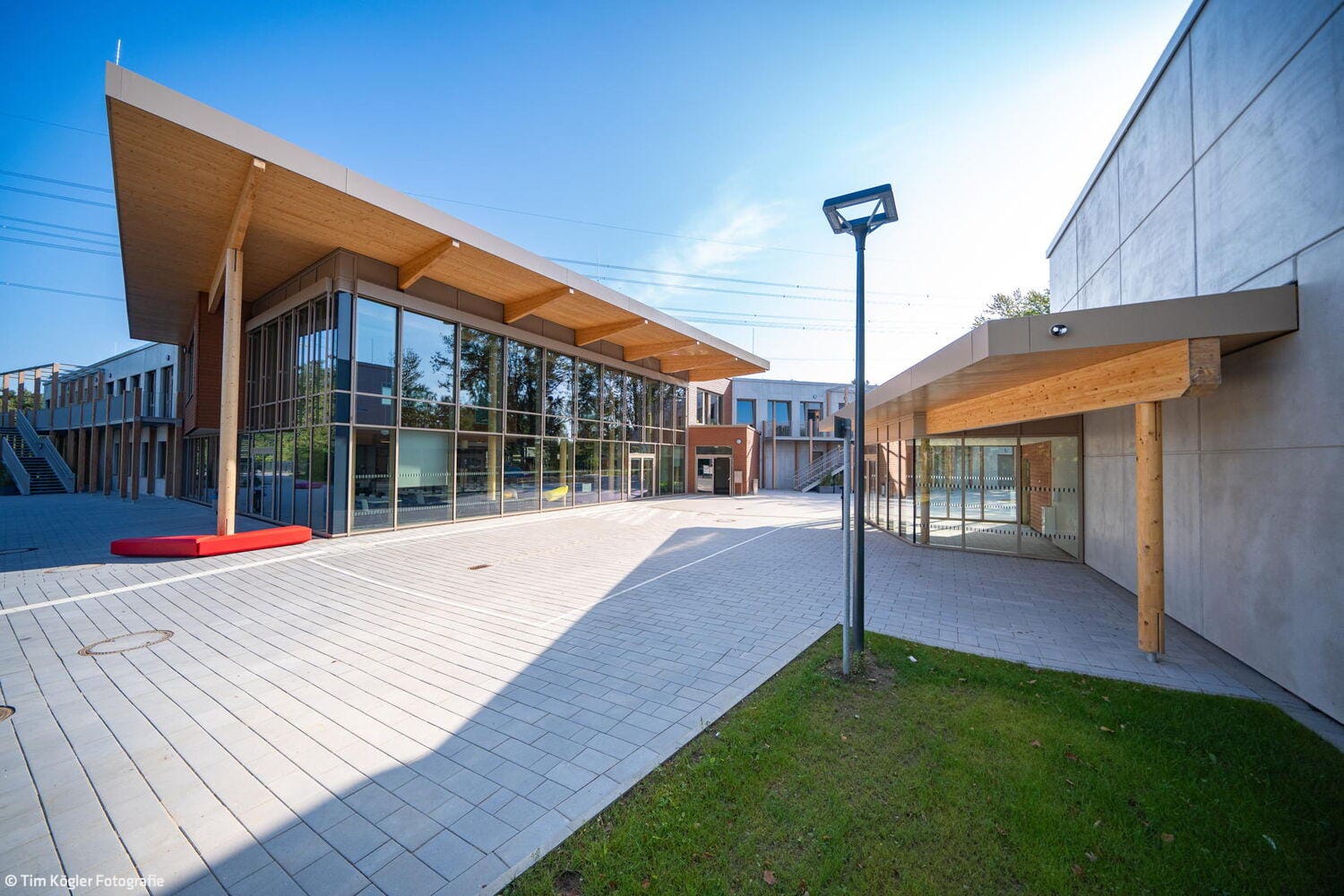
The two-story addition naturally completes the school complex's southeastern corner, thoughtfully framing the playground while providing a clean transition to the residential neighborhood beyond. It establishes a dialogue with the extension building west of the main structure, transforming the playground into the campus's true center. The dual-court sports hall with its changing facilities and equipment storage occupies the ground floor, while the upper level accommodates new administrative and all-day care spaces. Given the building's direct connection to the heritage-listed main building, its façade design demanded particular care. The original brick structure is defined by a uniform grid-patterned perforated façade, striking stair towers on its north face, and white wooden windows, with cornices articulating the base and eaves. The new building mirrors this approach with its own red brick façade.
The new building honors the linear grid rhythm of the existing façade through carefully composed window bands that reinterpret rather than merely replicate the original design language. Specific window configurations for classrooms, support spaces, and the cafeteria directly reference the historic building. The stairwells and central corridor are legibly expressed on the exterior. Projecting bay windows serving flexible learning spaces punctuate the strict grid as intentional compositional breaks. By adopting the same corridor system and eave heights, the new structure integrates seamlessly. The glazed joint between old and new deliberately recedes from both façade planes, ensuring each volume reads as distinct yet unified. This transparency at the threshold opens the building both visually and conceptually. Across material, appearance, and form, the ensemble achieves a cohesive architectural whole.
Photos:
Ralf Buscher
www.ralfbuscher.de
(Published in CUBE Hamburg 03|24)


Revealing Hidden Beauty
How Light Reveals the Distinctive Character of Powalla Forum
The architecture of tables
Sustainable Furniture as Spatial Design
Brought back to life
A Historic Villa Finds New Grace
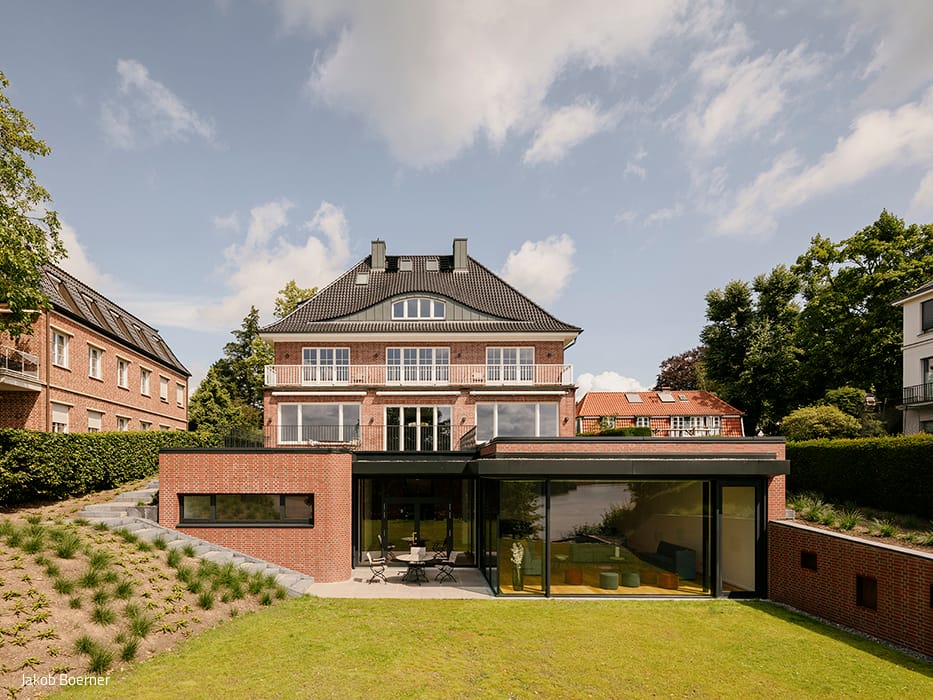
Revived
Scholarship fellows live and work in the historic country house on Elbchaussee