


Spreading out into the garden
The ISR kindergarten in Niederkassel impresses with its individual rooms.
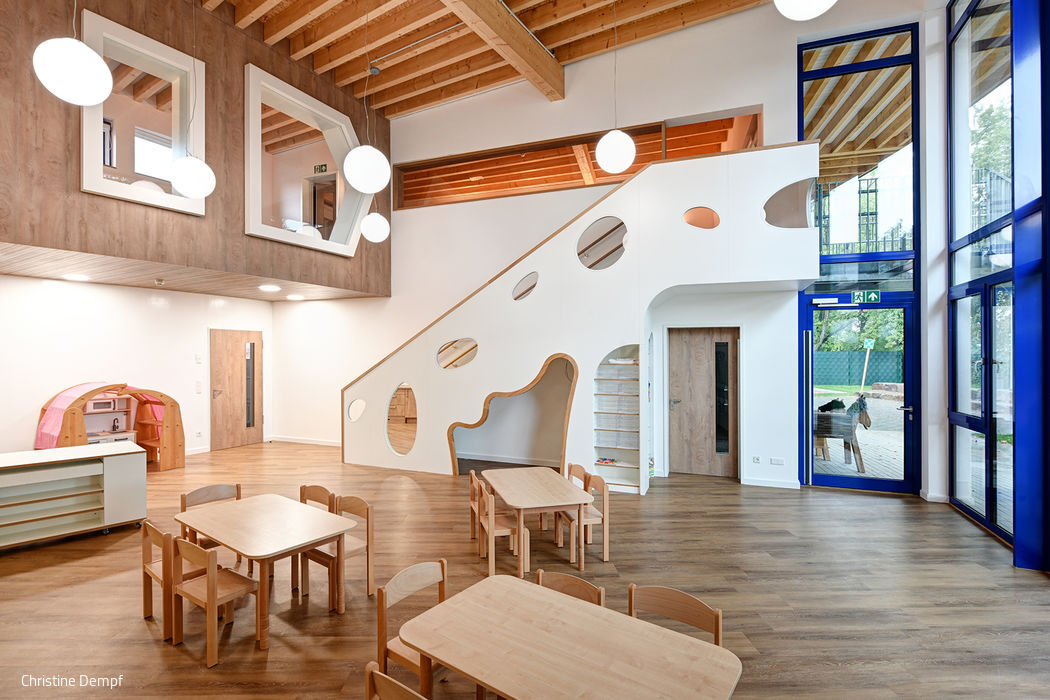


For almost 20 years, the International School on the Rhine (ISR) has been complementing the school landscape in Düsseldorf and Neuss with an English-language all-day school programme. A year ago, the school opened a new, expanded kindergarten in Niederkassel. Leckelt Architekten from Düsseldorf, who were commissioned with the design and execution, developed an unusual semi-circular structure that surprises with its spacious and individual rooms.
In the immediate vicinity of the Japanese school, the client was able to acquire the site of the vacant ballet school of the Deutsche Oper on a long-term lease. The dilapidated existing building was demolished and was to be replaced by a single-storey, detached building with sufficient outdoor space. The positioning of the new building on the site presented a major challenge, as the main road runs along the south side and it was not practical to use this area as a garden. The basic idea was to create a unique building for children that embodies the ISR's guiding principle – "We Enable Great Minds and Strong Characters" – in an individual spatial structure and architectural design. These considerations ultimately led to the concept of a semicircular structure that welcomes children with an inviting and protective gesture and provides them with sufficient indoor and outdoor space for growth and personal development. The straight longitudinal side was placed facing the street at the corner of the property, in keeping with the two- to three-storey neighbouring buildings. The central entrance area welcomes visitors under a semicircular forecourt, where prams and bicycles can be parked under a large glass roof. An adjoining, equally semicircular corridor leads to the four group rooms. These open generously onto the garden through large windows, with the room height rising from about three to six metres, giving each room a special quality. The sanitary areas are located between two group rooms. They are used by two groups and are generously sized with direct access to the garden.
The materials used were predominantly wood and glass. The large wooden roof, which towers above the building, is visible in all group rooms. It was designed to be sustainable and visually appealing with extensive green roofing. The large windows were constructed using aluminium. The wood-effect vinyl flooring gives the rooms a warm feel, as do the numerous individual wooden fixtures, which were planned with the carpenter. The high ceilings allowed for play galleries and sleeping areas above the sanitary facilities, each of which is connected to the group rooms via internal staircases. The group rooms have interactive whiteboards that encourage playful, pre-school learning. In terms of energy, the building was designed as a low-tech building: for example, the existing underfloor heating did not need to be supplemented by air conditioning.
Photography Credits:
Christine Dempf
www.christine-dempf.de
(Published in CUBE Düsseldorf 01|22)

Where Rhine Meets Alpine
The interior for an agency in Neuss: where spatial design brings the brand into sharp focus

Tailored Precision
A conversation with Düsseldorf architect Georg Döring on single-family homes, mentors, and fathers
Garden Getaway
A thoughtfully composed landscape of pool, sauna, outdoor kitchen, and relaxation spaces – designed for restorative living.
Maritime Monheim
The "Rheinkiesel" reconnect urban living with the Rhine