


A Courtyard Transformed
A historic malt house from a former brewery becomes a generous living sanctuary
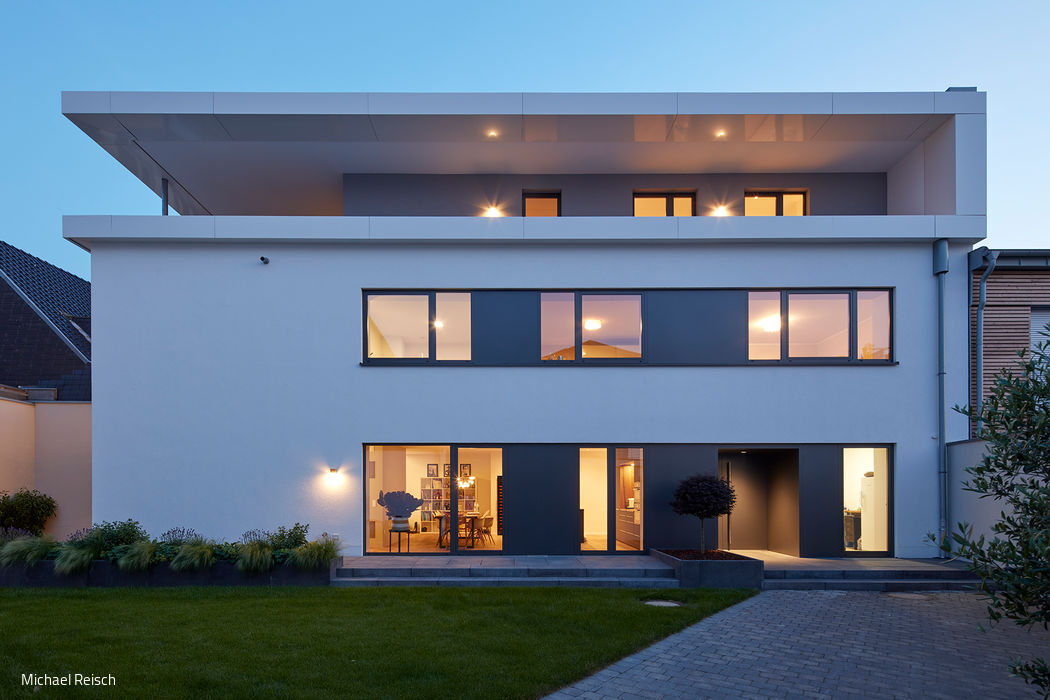


Converting backyards for residential purposes is no easy task. Existing buildings and uses, as well as neighbourhood rights, make it a complicated construction operation. Nevertheless, a feasibility study proved that the almost completely built-up backyard of a former restaurant in the city centre was suitable for the construction of a larger single-family home. E2 Architects from Meerbusch realised an exciting project that looks like a modern new building both inside and out, but is in fact a complex conversion.
The corner inn dates to the 19th century, while the brewery buildings scattered throughout the rear courtyard span multiple eras—including a historic gathering hall, a malt house, and various functional additions from the latter half of the 20th century. Only the brick inn retained sufficient heritage merit to warrant preservation; it was subsequently renovated and converted into an additional residential unit. Nearly everything else was demolished, with one significant exception: the 1867 malt house, which building codes required to be partially retained. Two of its four exterior walls functioned as fire barriers along the property line, necessitating their preservation. The decision preserved the building's shell and its existing vaulted cellar, yet a radical interior transformation was undertaken—so complete that virtually no trace of the original structure remains. The result: a liberated courtyard space, though with the inherent challenge of lighting a building accessed only from the north and east. The generously proportioned, cubic structure features an insulated plaster façade and anthracite-toned aluminium windows, meeting the neighbouring buildings directly on the western side. The building's volume mirrors the original malt house precisely—including its height, which allowed the expansive living room to soar across two storeys, flooded with light from a towering 6-metre east-facing window wall. External solar shading and nearby surrounding structures prevent the glass façade from overheating. An open tunnel fireplace serves as the threshold between the living area and kitchen, dining zone, and separate entry. North-facing panoramic windows dissolve the boundary between interior rooms and an outdoor terrace overlooking the courtyard's verdant landscape. Above the upper storey, the penthouse—sheathed in white aluminium panels—dramatically cantilevers backward: an imposing, deeply overhanging roof plane appears to hover weightlessly above the structure. Here, the owner's suite opens onto a sprawling corner roof terrace offering commanding views across the city's roofscape.
Living area: 220 m²
Plot size: 608 m²
Construction timeline: 13 months (3 months demolition)
Energy system: Condensing boiler with radiant floor heating
Construction method: Solid masonry
Photography Credits:
Michael Reisch
www.michaelreisch.net
(Published in CUBE Düsseldorf 03|21)
Traditional Living Reimagined
From Two-Family Villa to Multi-Generational Home

Sculptural Composition
In Gerresheim, cooperative housing brings together quality design and genuine affordability.
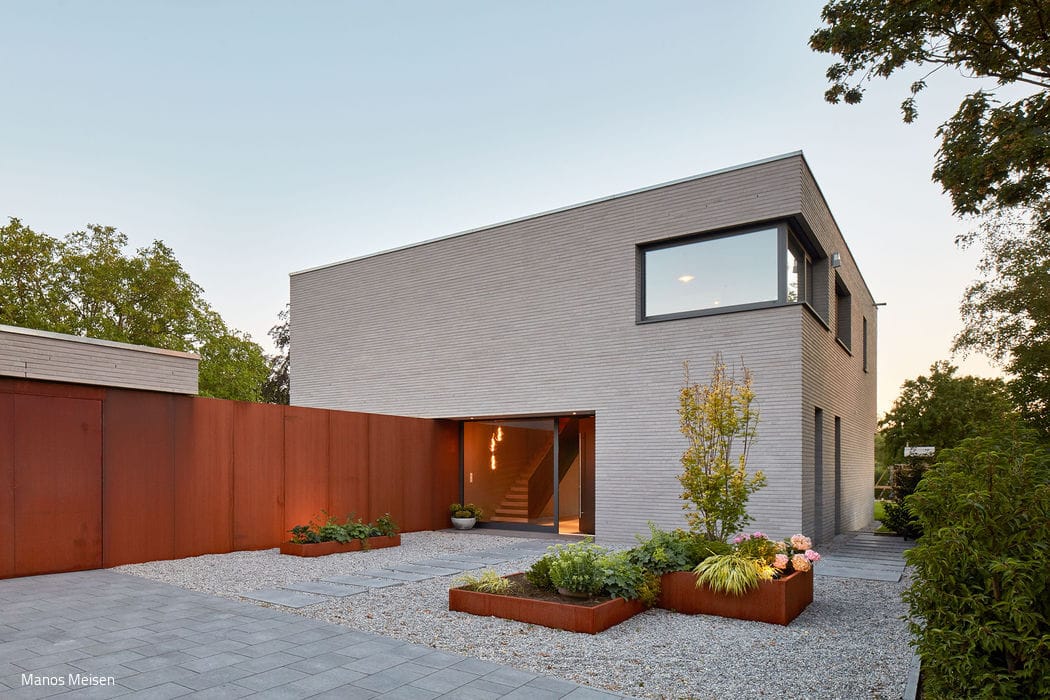
The Wall as the Primary Element
A town villa in Lank-Latum effectively combines openness and privacy.
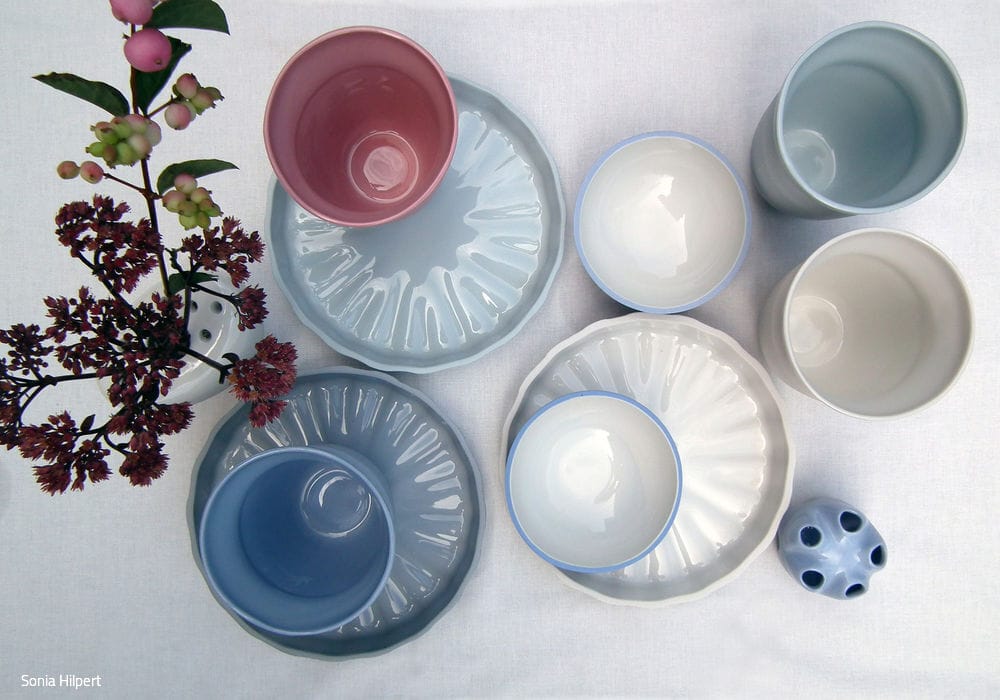
Beautiful Design for Every Day
At her ceramics studio, Petra Hilpert creates distinctive one-of-a-kind pieces and limited series.