


Learning from the Bees
The "Honeycomb House" – Barely Complete and Already Iconic


Bees have perfected the art of efficient design—stacking hexagons to create their ideal home. Munich architect Peter Haimerl drew inspiration from this natural form, nurturing an ambitious vision: to build a "honeycomb house" that would break free from the monotony of conventional rectangular architecture. His answer? A structure without a single right angle.
Munich's Wogeno housing cooperative, renowned for pushing architectural boundaries, approached architect Peter Haimerl with an ambitious challenge: design something entirely new, never before attempted. The result is the "Honeycomb House," now complete and nestled in the Messestadt Riem district. Haimerl's vision stacks hexagons vertically—four per column—with each column interlocking at zigzag junctions to create a striking pattern. Four rows high, five across, these cellular units merge into an unconventional yet cohesive residential structure. Access flows through the narrow end via a dramatic "sky staircase," distributing residents to floors housing one- to four-room apartments and larger multi-unit clusters. Intermediate landings on each floor branch left and right to individual flats. Creating connected living spaces from hexagonal cells demanded virtuoso spatial planning. A communal kitchen and shared lounge occupy the landing at the first stair's end. The obvious question: how livable are acute-angled rooms with dramatically sloped walls? Haimerl explains: "The hexagonal geometry enables intelligent spatial nesting, unlocking countless room configurations while generating surprising storage potential hidden within those angled surfaces." The project contains 22 units ranging from 22 to 106 m²—including one- to four-room maisonettes. Each hexagon measures 2.65 metres high, 6 metres wide, with walls angling at precisely 36.2 degrees. Three rows of cells stacked in depth create through-units with balconies on both façades. Since standard furniture proves incompatible with the geometry, Haimerl's team custom-designed all interior fittings. The architect acknowledges one limitation: "The building lacks barrier-free accessibility." To address this, he added a smaller, three-storey conventional garden house containing 15 apartments.
Photography:
Edward Beierle
www.edwardbeierle.de
(Published in CUBE Munich 03|24)


Where Hygge Meets Zen
This Munich ophthalmology practice is notable for far more than its striking design
Serenity in Motion
With smart design moves, privacy screens become landscape architecture.
Flowers & Co.
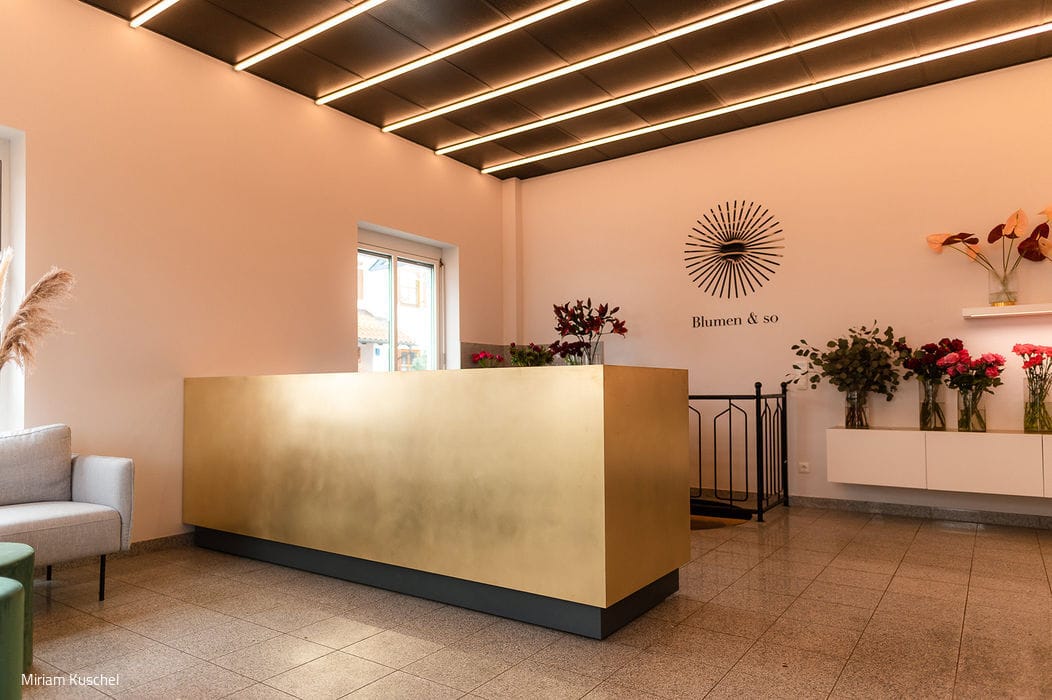
A florist's shop gets a complete creative transformation – on a shoestring budget.
Live better Lagom
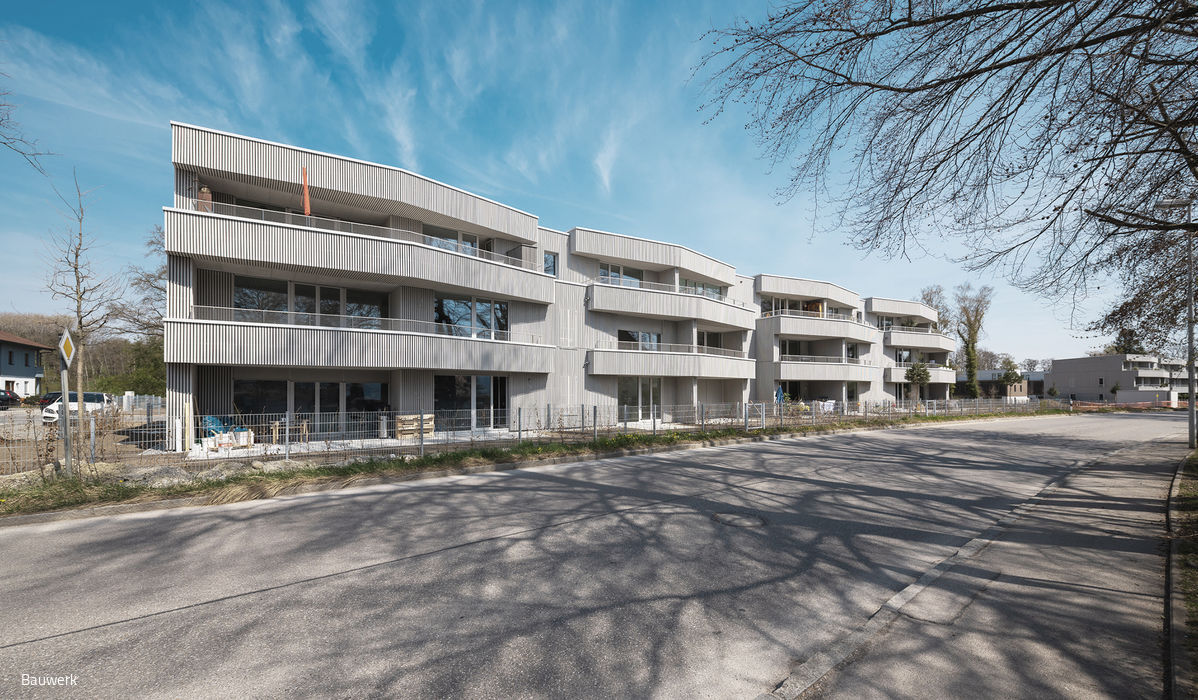
Scandinavian Design Meets Award-Winning Lakeside Living