


A Unifying Visual Statement
New school building featuring generous communal spaces and innovative energy systems
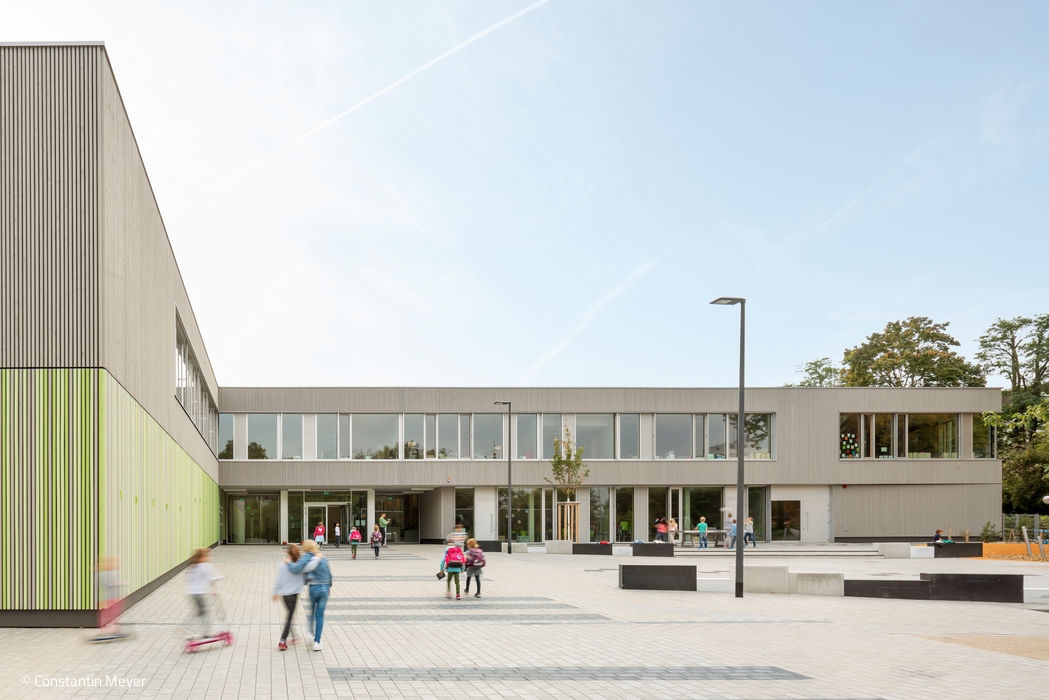


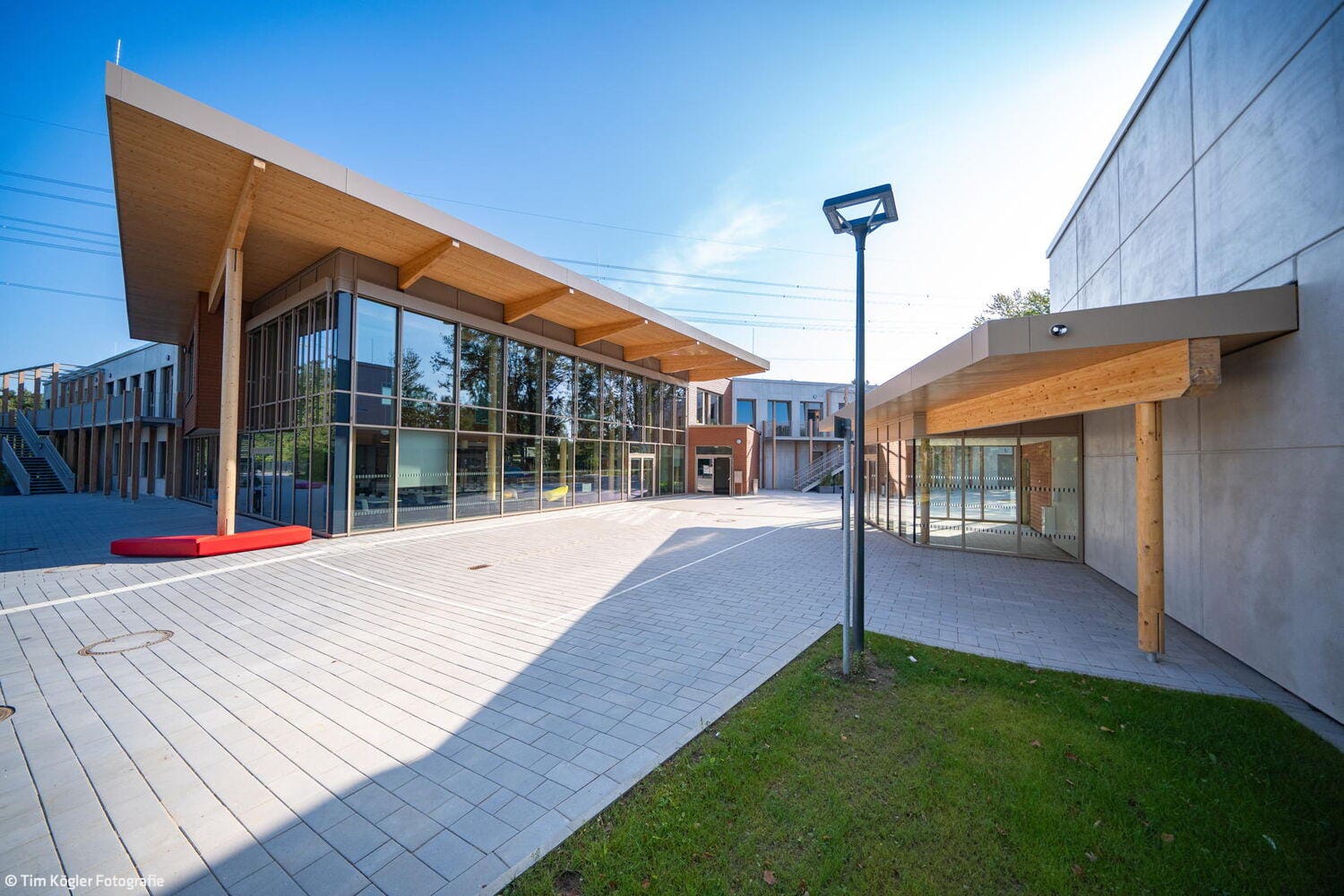
Rising enrollment in Berkersheim outgrew the capacity of the district's original school building in Frankfurt. When expansion on the existing site proved impossible, the Cologne-based architects at v-architekten designed a two-storey new facility on Schwarzer Platz, conceived for approximately 300 students. Inclusion became the defining principle guiding the design. The structure's distinctive wing-like form articulates three distinct outdoor zones, each supporting diverse activities: the main schoolyard facing the entrance, a garden court adjacent to the dining hall, and a service and delivery area. An existing, lush corner of the property offers additional opportunities—functioning as either a natural play area or woodland refuge within the schoolyard.
The heart of the school is an inviting two-storey assembly hall, equally suited for everyday breaks and large-scale school events hosting over 200 people. Its defining feature: a generous concrete and timber staircase. The seating steps do more than bridge the two floors—during events, they transform into spectator seating or a performance platform. "From this shared center," the architects explain, "you access the clearly organized functional zones of both floors. The open-air courtyards reinforce the spatial composition, flood adjacent corridors with natural light, and forge visual connections between levels."
The ground floor accommodates staff facilities and administrative offices alongside a multipurpose hall and dining area with adjoining school kitchen. For major school events, a mobile partition system transforms the dining and multipurpose spaces into a unified 220 m² area, which opens generously toward the garden courtyard through expansive floor-to-ceiling glazing. Students also benefit from a new library, computer room, and dedicated spaces for music and art. Classrooms occupy the first floor, opening broadly to the surrounding landscape. Team areas and flexible spaces for small learning groups complete the differentiated learning cluster zones.
The single-court sports hall serves both school and community sports. Accessible via a main corridor and an independent entrance, it remains available outside school hours. This new building functions as an energy pilot project. To evaluate ventilation systems and overall efficiency, two distinct strategies were installed side by side: the south wing operates with mechanical ventilation, while the west wing employs a sophisticated natural ventilation system using operable windows and corridor-integrated shafts. An ongoing monitoring program will document performance data and insights into long-term sustainability.
Photography Credits:
Constantin Meyer
www.constantin-meyer.de
(Published in CUBE Frankfurt 01|20)

Playful Curves
Residential quarter balances strict geometry with flowing forms
Reimagined
The heart of the house is an open-plan living space combining lounge, dining, and kitchen in an inviting, expansive design that offers plenty of...
Understated Elegance
A compact new building that elevates the learning experience for future physicians
A Fresh Heart
Historic Giessen Grammar School Transformed: Comprehensive Renovation Brings School into the Modern Era