


Thoughtfully Compact
The Hildegard von Bingen Secondary School in Sülz has been expanded to accommodate enhanced learning and sports programs.


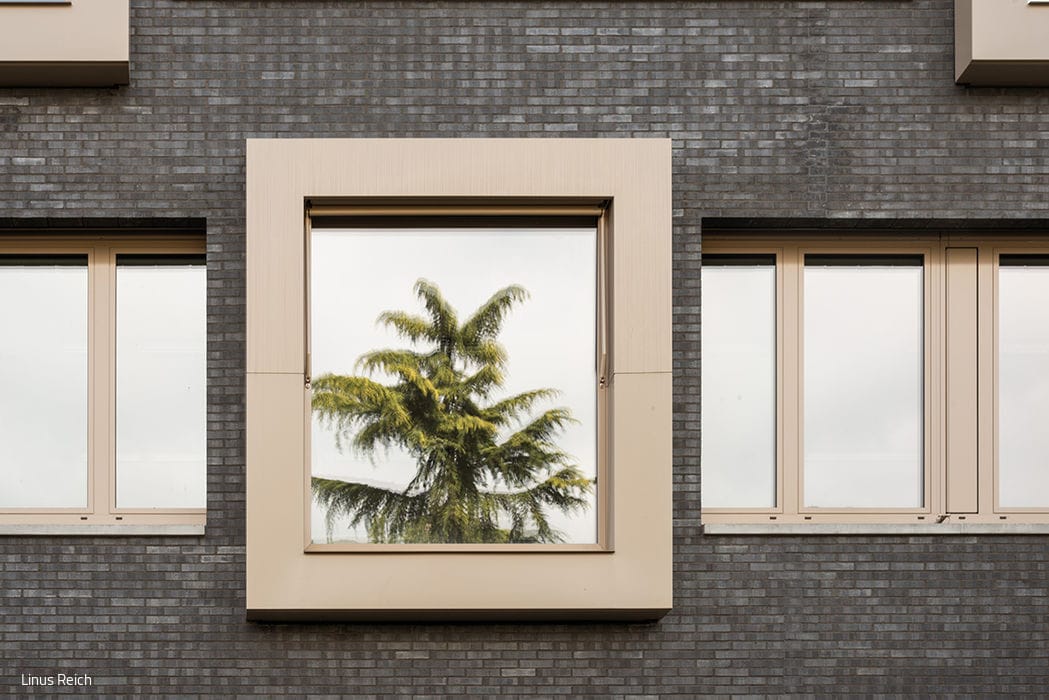
Cologne is renowned for its substantial collection of architectural gems from the 1950s. The Hildegard von Bingen Gymnasium on Leybergstraße in Sülz exemplifies this era: constructed between 1959 and 1961 to the designs of Cologne architects Berner & Jacobs, it showcases a steel skeleton structure clad in a striking exposed concrete grid façade. To respond to growing spatial demands driven by expanded all-day programming while enabling the school's designation as a North Rhine-Westphalia sports academy, the historic building required a sensitive extension and a new triple-use sports hall. The Cologne architectural firm kister scheithauer gross crafted a tightly organized solution featuring a brick façade, ribbon windows, and dynamically rhythmic aluminium frames.
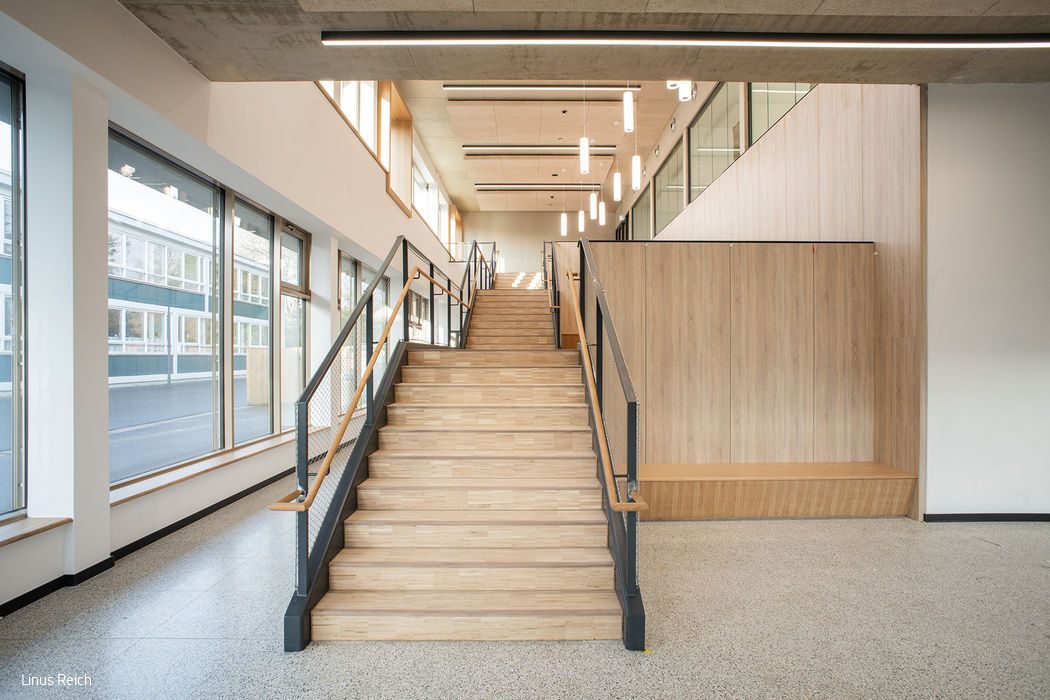
The school complex occupies a well-established position within its urban context. Both the site's character and the buildings' quality permitted only restrained interventions. The expanded program therefore fits within a compact addition. Positioned to reorganize and frame the schoolyard, this three-story structure opens from the main entrance into a generous, wood-lined foyer anchored by the primary staircase. This staircase doubles as a "learning staircase"—a terraced sequence of flexible teaching and study spaces. Classrooms occupy the first floor; specialized rooms, buffered from main circulation, sit above. Like the staircase, corridors function as hubs for both communication and focused work, with a central courtyard introducing natural light. The ground floor houses the library, media center, and self-study zones—all directly accessible to students, creating a fluid transition between the schoolyard, the building, and from leisure into structured learning. The three-court sports hall is set below grade but remains luminous: windows connect the playing fields to the library, while clerestory openings provide natural light. A separate entrance allows evening and weekend use for community sports and events. Landscape architect greenbox's open space design reinforces this approach through strategically positioned "landscape islands," which articulate the new schoolyard with varied social spaces.
Photography:
Linus Reich
www.larsgruber.de
(Featured in CUBE Frankfurt 02|23)


Spaces with Soul
A Cologne apartment transformed into a personalized sanctuary through thoughtful design decisions.
Classically Articulated
This residential building harmoniously resolves a complex urban situation, offering six bright three-room apartments...

The Larger Vision
A Bold Riverside Home in Leverkusen Creates Meaningful Links to Its Surroundings
Natural with a Distant View
A minimalist villa's garden dissolves gracefully into the Rhine floodplain landscape.