


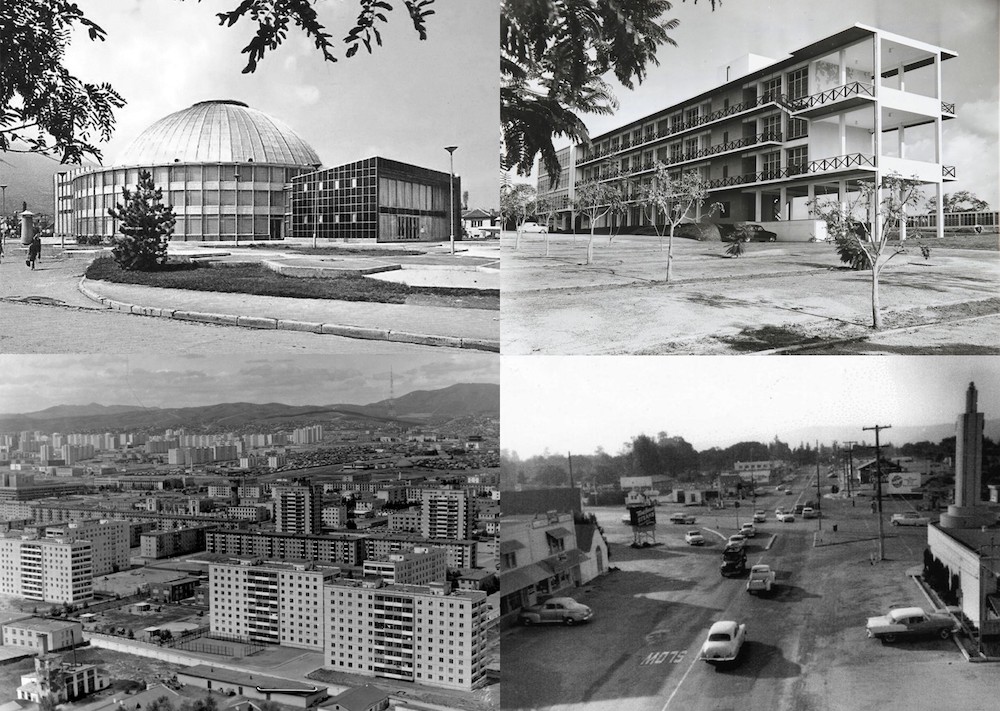
Archival images from the four cities: Top left: Universal Hall in Skopje, North Macedonia, 1964; Top right: KNUST University Campus in Kumasi, Ghana, 1957; Bottom left: Microdistricts III and IV in Ulaanbaatar, Mongolia, 1986; Bottom right: Highway 101 in East Palo Alto, CA, USA, 1937.
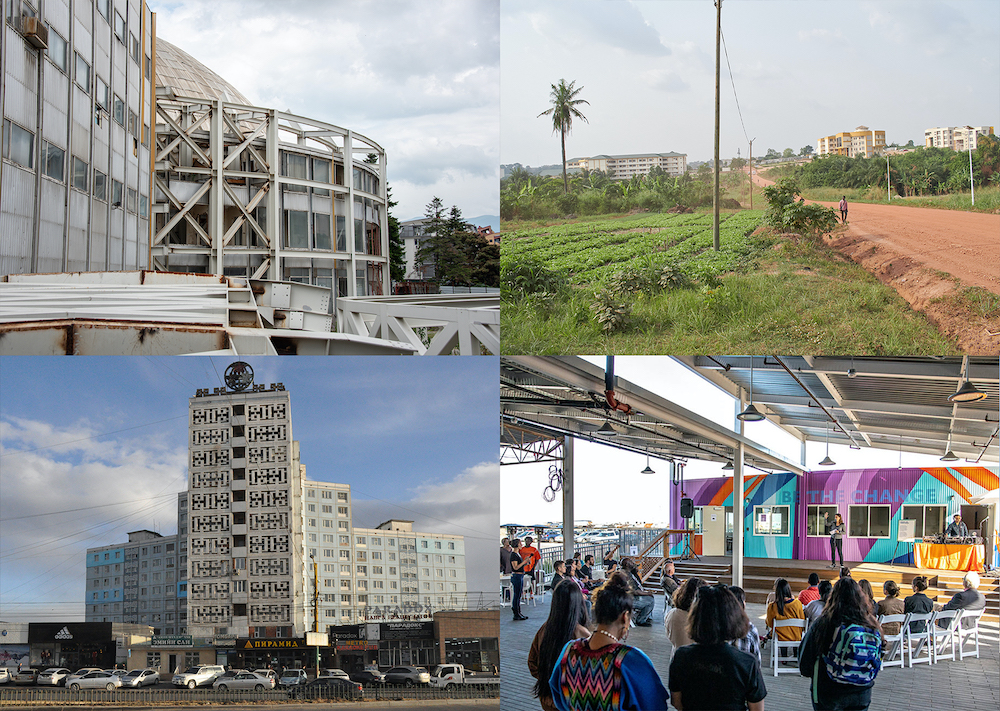
The four cities today: Top left: Universal Hall in Skopje, North Macedonia, photo: Mila Gavrilovska; Top right: KNUST University Campus in Kumasi, Ghana, photo: Joe Cann; Bottom left: Microdistricts III and IV in Ulaanbaatar, Mongolia; Bottom right: Bloomhouse, Emerson Collective in East Palo Alto, CA, USA.
The Gift: Generosity and Violence in Architecture
Exhibition at the Pinakothek der Moderne, February 29 – September 8
Architectural gifts take many forms: wealthy philanthropists underwrite libraries, humanitarian organizations provide emergency shelters, development initiatives support agricultural enterprises, Islamic foundations fund mosques, and stadiums are delivered as diplomatic gestures. Rooted in religious and imperialist traditions of gift-giving, these architectural donations shape urbanization across the globe. In rapidly expanding African, Asian, and South American cities—and their surrounding regions—humanitarian, development-focused, and diplomatic building donations have become commonplace. Similarly, in North American and European cities, so-called philanthrocapitalists are increasingly investing in cultural, social, and educational institutions vacated by the retreating welfare state.
This exhibition examines gifted buildings in all their forms—from the spectacular to the ordinary, from the extravagant to the genuinely useful—revealing how unequal power dynamics between giver and recipient can yield both benevolence and harm. What benefits does an architectural gift bring, and what damage might it inflict? We document how the act of giving and receiving architecture shapes these buildings' creation, affecting program, design, materiality, and labor practices. We investigate the economic returns and political leverage donors gain. We ask whether architectural gifts come with strings attached, and if so, what reciprocity looks like. We consider whether obligations between givers and recipients persist once construction ends. What becomes of a gifted building, and how do local communities embrace, maintain, and actually use it?
Working alongside local researchers and communities, we present case studies from four continents that reveal both the generative and destructive dimensions of architectural gift-giving. Featured are humanitarian gifts reshaping Skopje, North Macedonia; land gifted to Kumasi, Ghana; diplomatic donations to Ulaanbaatar, Mongolia; and philanthropic investments in East Palo Alto, California. The exhibition concludes by turning to Germany, examining how philanthropy continues to shape Munich and cities across the country today.
In Skopje, Ana Ivanovska Deskova is an architectural historian specializing in modern architecture, curator, and associate professor at the Faculty of Architecture at the University of Ss. Kiril i Metódij. In Kumasi, Kwasi Ohene-Ayeh serves as curator, critic, and lecturer in the Department of Painting and Sculpture at Kwame Nkrumah University of Science and Technology. In Ulaanbaatar, Uurtsaikh Sangi and Temuulen Enkhbat are researchers at GerHub, a nonprofit social innovation organization addressing urgent challenges in ger districts—the informal urban settlements of Mongolian cities. In East Palo Alto, documentary filmmaker Michael Levin has served the community for over two decades, while Leigh House, a heritage conservationist and doctoral candidate at the University of Michigan in Ann Arbor, brings scholarly expertise to the project.
More News

40 Jahre Stiftung Deutscher Architekten
Jubiläumsfeier im Düsseldorfer Medienhafen
Steinstraße Siebzehn
Die Gruppenausstellung Steinstraße Siebzehn versammelt…
Übertourismus
Haus der Architektur präsentiert Ausstellung

Euroshop 2026: Kraftvolles Statement
Messestand setzt auf Aufenthaltsqualität, Emotion und…