


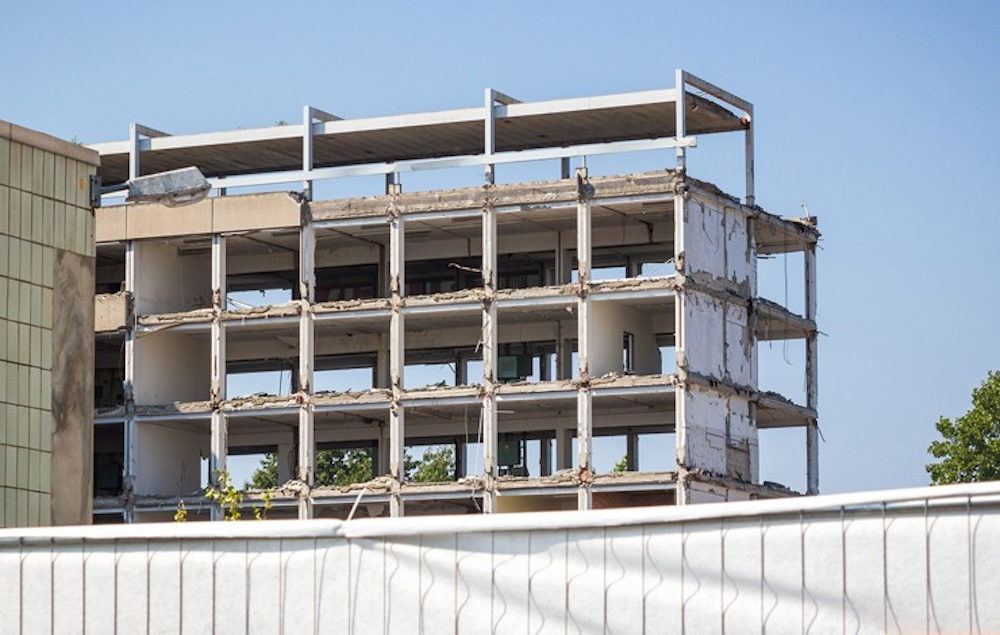
Photo: R. Vigh/IÖR Media
New Material Cadastre Now Available
Building Material Distribution Data Across Germany's Existing Building Stock
The construction sector is among the world's largest environmental polluters. It drives enormous consumption of natural resources and generates massive quantities of greenhouse gases—while producing millions of tons of construction waste annually. Reversing this trend requires more recycled building materials and reused components. Now, researchers at the Leibniz Institute of Ecological Urban and Regional Development (IÖR) are providing a crucial foundation for circular construction with the "Material Register Germany." For the first time, comprehensive data on building material composition and distribution across Germany's entire building stock is available nationwide.
The construction industry consumes nearly 45 percent of global resources and ranks among the world's largest greenhouse gas emitters, particularly CO₂. These emissions stem not only from heating and cooling buildings, but also from manufacturing building materials, transporting them to sites, and the construction process itself. "Grey emissions"—those embedded in material production—continue to grow, making it difficult for countries like Germany to meet Paris Climate Agreement targets in the construction sector. Meanwhile, demolished buildings release staggering quantities of waste materials—over 200 million tons in Germany in 2022 alone, more than half of all waste generated. "If we extended material lifecycles and recycled building components after demolition—essentially building circularly—the construction industry could significantly reduce its climate impact, preserve resources, and cut pollution," notes Georg Schiller, head of the "Anthropogenic and Natural Resources" research group at the Leibniz Institute. Yet this requires essential data: precise information on which materials are used in buildings, in what quantities, and how they're distributed across the building stock. Until now, this foundation was missing.
The IÖR's Material Register Germany now makes this critical database publicly available for the first time—covering every municipality nationwide. Data from 2022 reveals that Germany's 51.6 million buildings contain roughly 20.8 billion tons of building materials. Concrete dominates this inventory at 46 percent, followed by sand-lime brick and clay brick, each accounting for nearly 10 percent. Renewable materials like wood, reed, and straw represent just one percent. The register also quantifies embodied carbon: the materials in Germany's 2022 building stock contain approximately 2.86 billion tons of CO₂ equivalent—equivalent to Germany's total emissions over four years. Combined with local demolition and new construction data, the register enables municipalities to estimate which materials become available for recycling and which local material needs could be met through recovery. It also forecasts expected construction waste volumes.
The register builds on 3D building models of Germany's entire building stock, provided by the Federal Agency for Cartography and Geodesy (BKG). These models are enhanced with additional information and classified by building function—distinguishing residential from non-residential structures and further subcategories. "The result is a detailed portrait of German buildings," explains Reinhard Schinke, who led the development. "Using 3D models, we know structural volumes and can categorize each building—residential home, factory hall, single-family house, or apartment block. From there, we determine which materials and quantities are typical for each type." The team assigns material coefficients to building categories based on decades of IÖR research. "We analyzed typical construction methods for each building type—from foundations through walls, ceilings, and roofs—identifying standard materials and quantities for each component. We track 44 distinct building material groups," notes Schiller. Concrete predominates in factory halls and office towers, while residential buildings rely more on brick and wood. These material profiles reflect the composition of different building types. The coefficients are accessible through the IÖR's "Information System on the Built Environment (ISBE)" and provide the crucial foundation for the register's reliability. The register itself—linking geodata with material coefficients—is available in the "ioerDATA" repository.
The IÖR Material Register Germany currently employs building-by-building analysis, making the data exceptionally valuable—it provides benchmarks for typical material compositions of comparable buildings. This opens strategic opportunities for developing regional material cycles and planning circular cities now. "Combined with demolition and construction data, municipalities could realistically assess how concrete recycling contributes to local raw material needs and identify policy levers to support circular construction," illustrates Schiller. Broadly, the Material Register Germany supplies essential data for diverse planning scenarios involving efficient material management in the existing building stock, reducing costs of data acquisition. However, individual building construction details necessarily remain approximate. "The type-based approach overlooks unique characteristics. At the individual building level, we cannot provide exact data on a specific structure's actual material composition," Schiller clarifies.
Municipalities, architecture firms, large property owners, consulting firms, and circular construction startups can all leverage this data. They can apply it directly or combine it with proprietary, more granular information to develop business models—building material passports, sustainable deconstruction and reuse strategies, pre-demolition audits, and more. Recycling companies find value here too, as the data supports forecasting future demolition materials and building viable business models. "Research into the Material Register Germany's foundations has occupied us at IÖR for over a decade—and we're far from finished," Schiller notes. The team continues refining methods and data to expand applications. "Greater precision could come from deeper building differentiation—accounting for construction period, for instance. A pre-war apartment building contains fundamentally different materials than one built in the 1950s post-war reconstruction. Assessing contamination risks could follow naturally." As with ongoing research, IÖR collaborates across the circular construction field—planning offices, government agencies, and industry partners—to maximize the data's impact.
More News
Community Happens Here
Community-building projects at the Architecture Gallery…
O.M. Ungers – Architecture as Idea
Exhibition at the Museum of Applied Arts
Cobe – In Transformation
Exhibition at Architecture Gallery Berlin
Aukett + Heese Honored as "BIM Champion 2026"
Honour in the category ‘From planning to…’