


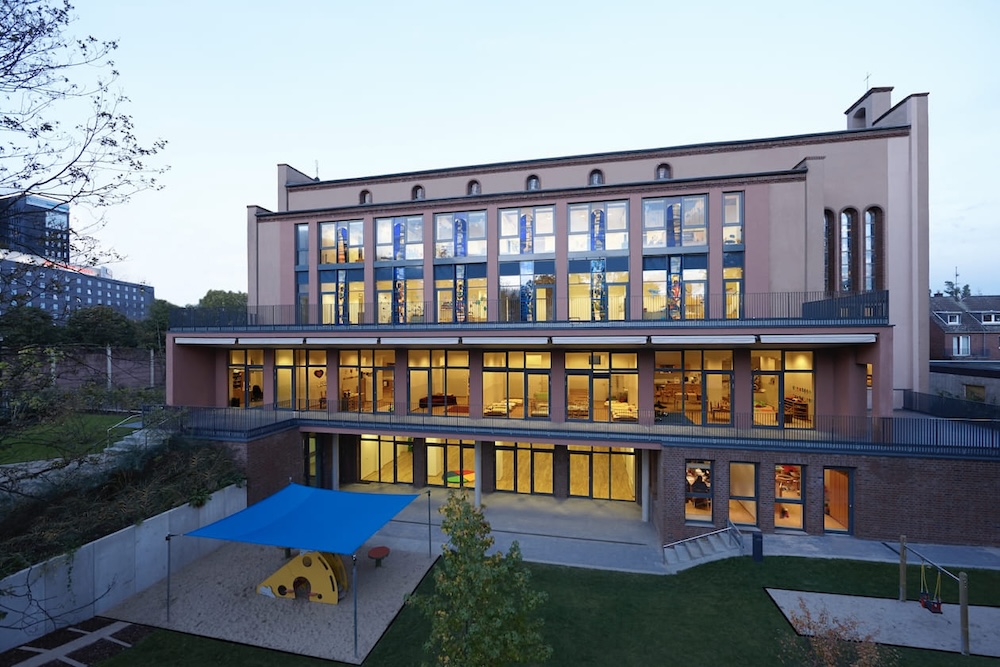
Christ the King, Düsseldorf Photo: Max Hampel
Churches as fourth places – perspectives on transformation
Exhibition on transforming vacant churches
Finding new purpose for vacant churches – that's the focus of "Churches as Fourth Places – Perspectives on Transformation," an exhibition opened by the Museum of Building Culture NRW on Sunday, November 9, 2025, at the Berger Church in Düsseldorf. Running through December 13, the exhibition showcases how North Rhine-Westphalian churches are being reimagined as family centers, aikido dojos, bicycle shops, and more. But what challenges does this transformation present for architects? How do church buildings shape urban development, and how can stakeholders, municipalities, and local initiatives forge meaningful dialogue around repurposing these structures? Many church buildings across the region now face an uncertain future – vacancy and demolition loom large. Yet these spaces represent far more than architectural heritage; they are vital community hubs bound to the memories and emotions of generations. The conversion processes reflect this complexity, often proving lengthy and contentious, with outcomes shaped largely by the dedication of those involved. From November 9 to December 13, 2025, the Museum of Building Culture NRW places the spotlight on these passionate individuals – those spearheading church transformations for varied reasons – through the exhibition "Churches as Fourth Places – Perspectives on Transformation," presented at the Berger Church in Düsseldorf. Opening reception: Sunday, November 9, 2025, at 6 p.m.
Today's society needs gathering spaces now more than ever – places where people connect and find shared identity. Church buildings offer something uniquely suited to this purpose. Their architecture anchors identity within the urban landscape, they provide room for exchange, spiritual reflection, and quiet contemplation, and they possess distinctive atmospheres charged with emotional resonance. In this way, churches create something distinctive: a "fourth place" – one that transcends the conventional role of community meeting spot (the so-called third places). The Museum of Building Culture NRW brings this vision to life through video interviews that reveal the full spectrum of people driving these conversions and the varied perspectives they bring. How does an architect tackle such a redesign? What does a longtime parishioner feel at the final service? How does a pastor guide the transition? Where does a property developer fit in? Throughout, the exhibition emphasizes dialogue, collaboration, and the art of reaching meaningful compromise.
The exhibition also highlights churches across North Rhine-Westphalia that have already undergone successful conversion. Twenty-seven projects are presented through photographs and narrative, including the Christus-König Church in Düsseldorf (now a family center), Cologne's Dreifaltigkeitskirche (home to an aikido dojo), the Friedenskirche in Bochum (community center), St. Rochus in Jülich (bicycle shop), and Essen's Kreuzeskirche (adapted for both worship and events). These examples illustrate the remarkable range of approaches – both programmatic and architectural – to church transformation. The exhibition also addresses practical matters: heritage protection, municipal responsibilities, and canon law. "Churches as Fourth Places" catalyzes new thinking and opens conversations about the future of spaces no longer needed for traditional worship. Complementary discussions connect local congregations, residents, civic associations, and community groups, fostering the exchange of ideas and shared vision.
The Berger Church, the exhibition's venue, stands as one of Düsseldorf's most significant architectural landmarks. This modest hall church was consecrated in 1687 as the city's first Lutheran place of worship. Set somewhat discreetly – accessible only through a courtyard at Berger Straße 18 – its location itself tells a story: it marks the precarious position of Lutherans in a recatholicized Düsseldorf. Largely destroyed during World War II in 1943, the church was carefully reconstructed in the 1960s and reconsecrated in 1966. Artist Tobias Rehberger designed its contemporary interior: geometrically patterned wall hangings with subtle color gradations line the sides, while a clean white acrylic glass altar anchors the space. Beyond the church walls, the Psychosocial Centre Düsseldorf established a memorial garden in 2011 – a dignified space where refugees and migrants can honor loved ones they cannot visit. Every Tuesday, a pop-up pastoral service welcomes the community. Though no longer active as a parish church, the Berger Church now hosts cultural events and gatherings, blending its rich history with present-day spirituality and an open embrace of the broader urban community. Its future role remains to be defined.
The Museum of Building Culture NRW presents this exhibition as churches and their congregations face a pivotal moment. Across Germany, between 30 and 50 percent of church buildings will likely stand vacant in the coming decades. In North Rhine-Westphalia alone, this could mean up to 3,000 of the region's roughly 6,000 churches falling out of active use. Until recently, church institutions largely avoided confronting this trend; today, the urgency to act and reimagine these structures has become impossible to ignore.
More News

40 Jahre Stiftung Deutscher Architekten
Jubiläumsfeier im Düsseldorfer Medienhafen
Steinstraße Siebzehn
Die Gruppenausstellung Steinstraße Siebzehn versammelt…
Übertourismus
Haus der Architektur präsentiert Ausstellung
Euroshop 2026: Kraftvolles Statement
Messestand setzt auf Aufenthaltsqualität, Emotion und…