


A House with a Gymnasium
Where Tradition Meets Modernity – A Detached Home in the Bavarian Forest
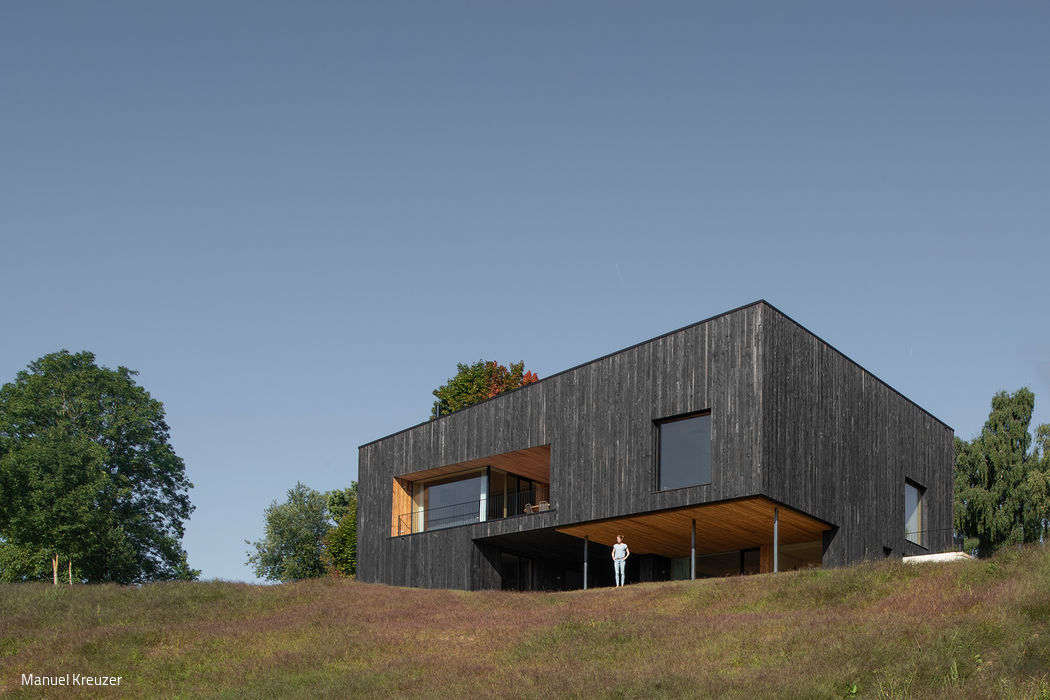
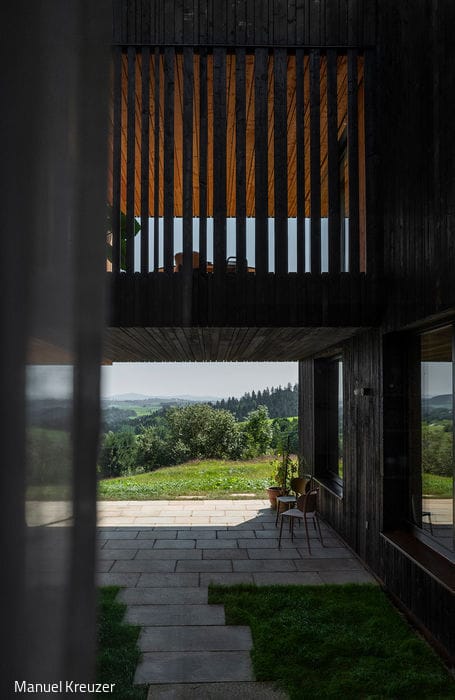


From afar, this new residence resembles a smoothly polished boulder, nestled against the rolling hills of the Bavarian Forest. Its construction faced challenging site conditions. Studio Tobias Hofmann from Passau designed the building, commissioned by a family seeking a detached home with an added feature: a private gymnasium for everyday use. The sloping site faces south, offering both sweeping vistas and intimate views—idyllic ponds in the foreground, a forested ridge, a small pilgrimage chapel in the valley, and beyond it, the seemingly boundless panorama of the Waldbuckelwelten forest landscape.
The architect arranged the two volumes to create a small courtyard between them, linking the gymnasium and residence through distinct visual axes. Both sections, oriented downslope, are further unified by the perpendicular upper floor on the north side and the cantilevered terrace to the south—a composition that reads as a single monolithic form. The roof planes trace the hillside in serpentine fashion, echoing the characteristic undulating lines of the Bavarian Forest's ridges. Set slightly apart, the garage screens the residence from the street while anchoring itself to the slope, creating a sheltered courtyard where children can skate and play—and serving as the primary approach to the house. Inside, the gymnasium and living quarters connect through a central entrance hall. The intentionally minimal living space opens generously toward the landscape, with kitchen and dining windows framing both the gymnasium interior and the distant pilgrimage chapel. Nearly all other rooms occupy the garden level, oriented toward the gymnasium-shaded terrace. The upper floor contains only two small offices and a roof terrace—an ideal spot to linger in the evening sun during summer months. The floor plan masterfully blends classical modern with traditional elements: the historic "Flez" (parlor) and Stube meet contemporary open-plan living and light-filled spaces. The hybrid concrete-and-wood construction references regional building practices, as does the charred larch façade. While Yakisugi has Japanese origins, blackening wood for protection is equally rooted in Bavarian tradition—a practice only recently displaced by industrial tar treatments.
Photography Credits:
Manuel Kreuzer
www.studio095.de
(Published in CUBE Munich 01|23)

Five Apartments with Varied Floor Plans
Variety by Design—Each Unit Tells Its Own Story

Lakeside Housing Ensemble
Hybrid Timber and Concrete Residential Development in Utting am Ammersee
Timelessness and Quality
Swabian Innovator: Redefining Furniture Manufacturing
A Striking Transformation
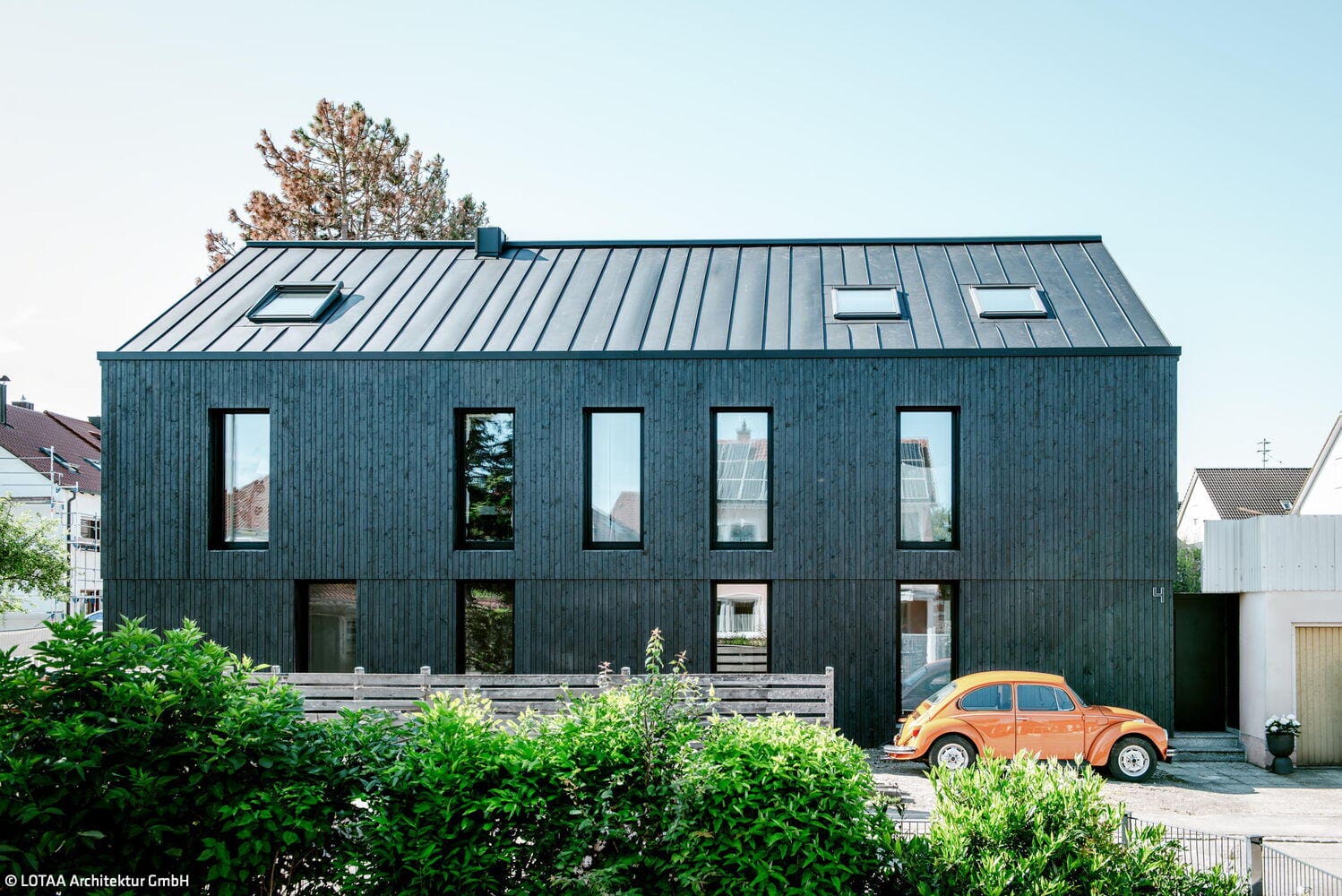
55 Years On: How a Classic 1968 Two-Family Home Got a Complete Makeover