


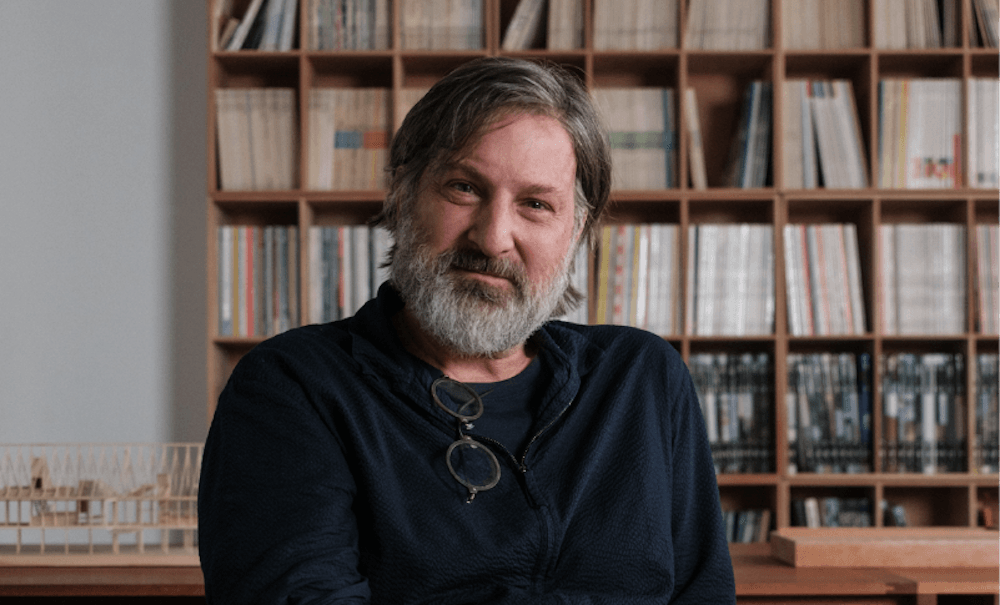
Smiljan Radić Clarke wins the Pritzker Architecture Prize
Top architectural award presented
The Pritzker Architecture Prize has announced Smiljan Radić Clarke of Santiago, Chile, as the winner of the 2026 Pritzker Architecture Prize, the award widely regarded internationally as the highest honour in architecture. Radić rejects a repeatable architectural language; instead, each project is approached as a unique investigation grounded in fundamental principles and rooted in a non-linear history. Context, use and anthropological awareness take precedence. Place is understood not only in physical terms, but also as a convergence of history, social practice and political circumstances. The 2026 jury citation states, among other things: “Through a body of work situated at the intersection of uncertainty, material experimentation and cultural memory, Smiljan Radić favours fragility over any unwarranted claim to certainty. His buildings appear temporary, unstable or deliberately unfinished – almost on the verge of disappearing – yet offer a structured, optimistic and quiet, cheerful shelter that recognises vulnerability as an intrinsic condition of lived experience.”
In his works, site-specific strategies recur in various forms, enabling each building to emerge from its unique conditions rather than from a standard formula. Buildings may be partially embedded in the ground rather than simply placed upon it, as in the Mestizo restaurant (Santiago, Chile 2006), be oriented to provide protection from prevailing winds or harsh light, as in the Pite House (Papudo, Chile, 2005), or be shaped through adaptive reuse rather than replacement, as in the case of Chile Antes de Chile, the extension of the Chilean Museum of Pre-Columbian Art (Santiago, Chile, 2013). “In every work, he is able to respond with radical originality and make the non-obvious obvious. He draws on the most irreducible fundamentals of architecture whilst simultaneously exploring frontiers that have not yet been touched. Developed in a context of relentless circumstances, on the edge of the world, with a practice of just a few staff members, he is able to take us to the very core of the built environment and human existence,” comments Alejandro Aravena, chair of the jury and 2016 Pritzker Prize laureate.
Radić’s architecture reveals its rigour not through formal assertion, but through the discipline of its construction. His works often appear austere or elemental, yet this impression conceals precise technique and construction. Materials such as concrete, stone, wood and glass are used in a deliberate interplay to shape weight, light, sound and form. In the Serpentine Gallery Pavilion (London, United Kingdom, 2014), a translucent fibreglass shell rests upon massive load-bearing stones sourced from the region. Light is filtered rather than projected, and the enclosure remains partially open, allowing visitors to enjoy shelter without being completely separated from the surrounding park. At the Teatro Regional del Biobío (Concepción, Chile, 2018), a carefully constructed semi-transparent shell modulates the light and enhances the acoustic performance through restraint. Construction becomes a form of storytelling in which texture and mass are just as significant as form.
The jury’s statement continues: “It is inherently difficult to convey the qualities of his architectural work in spoken language, for in his designs he works with dimensions of experience that are immediately perceptible yet elude verbalisation – much like the perception of time itself: instantly recognisable, yet conceptually elusive. His buildings are not simply conceived as visual artefacts; rather, they require an embodied presence.” His works are characterised by a quiet emotional intelligence, marked by empathy for the human experience and attuned to how architecture is perceived over time. His buildings appear protective, inward-looking and mindful of human fragility. “House for the Poem of the Right Angle” (Vilches, Chile, 2013) embodies contemplative retreat, with carefully placed openings oriented upwards to capture light and time and foster silence and self-reflection.
In his home studio, Pequeño Edificio Burgués (Santiago, Chile, 2023), the residence offers shelter and privacy whilst maintaining a sense of connection with the city below. From inside, the occupants look out onto the urban landscape below, whilst the interior remains concealed from view behind wire mesh curtains. Single-pane glass walls invite rain, sounds and shifting light into the space, making the daily weather both tangible and visible. Below, the underground studio is situated in a quieter location, as the same walls are softened by an earth embankment that filters sunlight, reveals nature and creates a sheltered working environment. Interventions are neither restoration nor replacement, but rather deliberate calculations of scale and use. At NAVE (Santiago, Chile, 2015), Radić redesigns a listed residential building from the early 20th century, which was damaged by a natural disaster, by retaining the existing structure whilst inserting new volumes dedicated to open performance, rehearsal and workshop spaces. Above, a roof terrace covered by a circus tent creates an unexpected lightness and an atmosphere of provisional festivities with communal events, contrasting with the down-to-earth intimacy below. Previous layers remain visible, and adaptation is viewed as continuity rather than compromise.
This focus on layers extends beyond the building itself. In 2017, Radić founded the Fundación de Arquitectura Frágil in Santiago, conceived both as a platform for public exchange and as a working archive. The foundation’s collection, comprising experimental works, studies and references by other architects, forms a body of research that frequently informs his own projects. The work of others becomes a further layer through which architecture continues to evolve. Radić’s practice, developed over more than three decades, encompasses cultural institutions, public spaces, commercial buildings, private homes and installations across Albania, Austria, Chile, Croatia, France, Italy, Spain, Switzerland and the United Kingdom, with further defining works including Guatero for the XXII Chilean Architecture Biennial (Santiago, Chile, 2023); London Sky Bubble (London, United Kingdom, 2021); Chanchera House (Puerto Octay, Chile, 2022); Prism House (Conguillío, Chile, 2020); Vik Millahue Winery (Millahue, Chile, 2013); The Boy Hidden in a Fish, with Marcela Correa, for the 12th Venice International Architecture Biennale (Venice, Italy, 2010); and CR House (Santiago, Chile, 2003). Smiljan Radić Clarke is the 55th recipient of the Pritzker Architecture Prize and founder of the firm Smiljan Radić Clarke, established in 1995. He was born in Santiago, Chile, and lives and works in his hometown, with upcoming projects in Albania, Spain, Switzerland and the United Kingdom.
More News

Minotti Opens New Flagship Store
Collaboration with renowned partner from Cologne

Dirk Reinartz: No Lovelier Land…
Exhibition at f³ – freiraum für fotografie

Luisa Baldhuber. Afterglow
Exhibition at Haus der Kunst

Autumn-Winter Auction 2024
Featuring art, design, antiques, jewelry, and more