


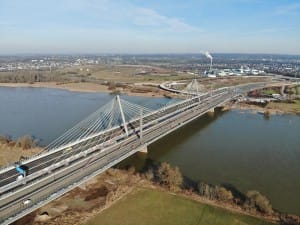
Opening Day | Photo: Autobahn GmbH

Construction Progress, Summer/Fall 2023 | Photo: Autobahn GmbH
⠀

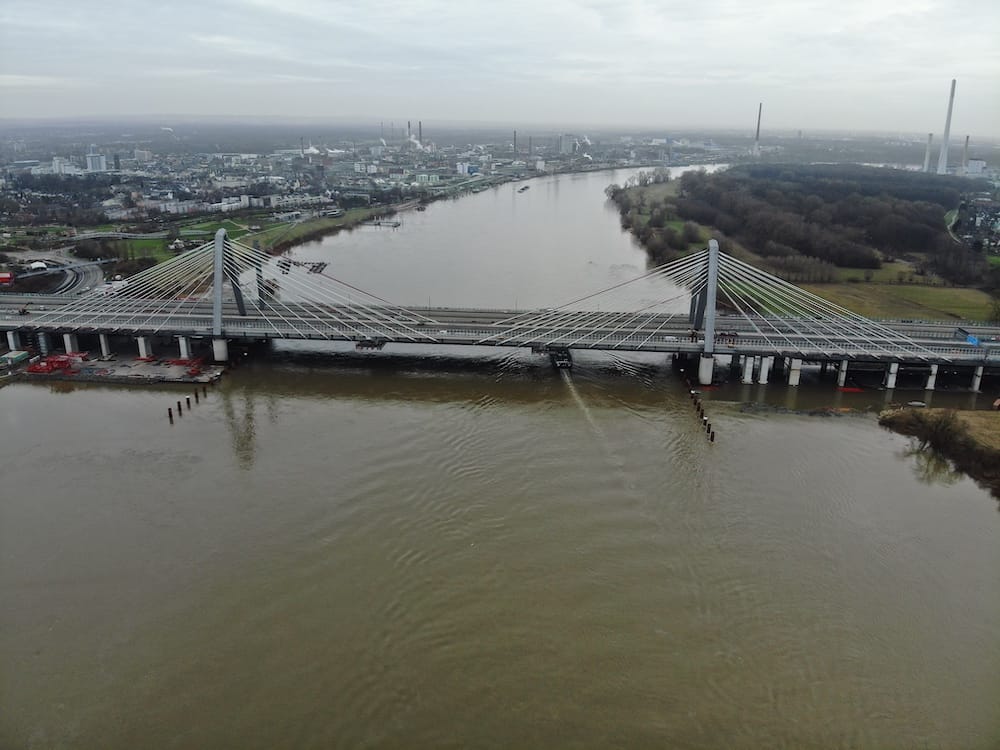
Photo: Christoph Seelbach Photography
New Rhine Crossing
New Leverkusen Rhine Bridge Opens to Traffic
Since early February, traffic has been flowing smoothly across the Rhine once again. After six years of construction, the first half of the new Leverkusen Rhine bridge has opened to commuters and long-distance travelers alike. This represents a critical breakthrough in preventing the traffic gridlock that threatened to paralyze one of Europe's most vital transportation corridors.
This new structure replaces the aging Rhine bridge from the 1960s, which had deteriorated to the point where it could only accommodate traffic under strict weight and speed limits due to critical structural damage. Designed by Munich-based architects Firmhofer + Günther, the new crossing features a dual cable-stayed bridge configuration, with each span offering six lanes finished in quiet-surface asphalt, plus two nearly four-metre-wide dedicated paths for cyclists and pedestrians.
The design's signature elements are the white bridge pylons, which angle subtly at their peaks—creating a visual conversation between the two spans and unifying them into a cohesive ensemble. The overall impression is one of elegant minimalism, a quality that extends beyond what meets the eye. Engineering firm Grassl, responsible for planning the entire A1 motorway section including approach bridges and interchanges, integrated an innovative girder grid system that reduces steel consumption by over 30 percent, making the project a model of resource-conscious engineering. The bridge's second section is slated for completion in 2027.
More News

Fantasies of "the Other"
Exoticizing architecture in Stuttgart from the 19th century…
Rental Housing and the Housing Question
Exhibition at Tuntenhaus

The City is the Sport
Cities in motion: examples from across Europe

Unleashed colours
Pop-up exhibition by Temel Nal at Kustermann Pop-up