


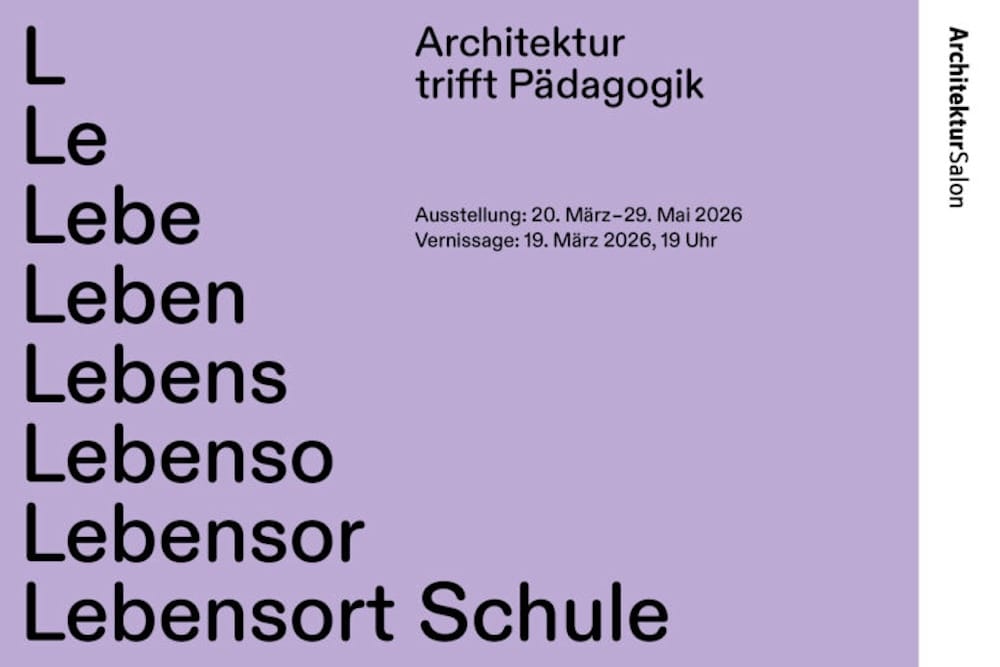
School as a place of life
Exhibition showcases outstanding school building projects
What does a good learning environment look like? The exhibition “School as a Place of Life” at the ArchitekturSalon Hamburg showcases outstanding school building projects from Scandinavia, Germany, the Netherlands and Switzerland that combine innovative educational and architectural concepts. The exhibition opening will take place on Thursday, 19 March 2026 at 7 pm in the presence of the curatorial team and other invited guests.
Speakers at the opening:
Kristina Bacht, ArchitekturSalon Hamburg
Barbara Pampe, Director of the Montag Foundation for Youth and Society, Bonn
Kirstin Bartels, architect and school building consultant, Hamburg
Susanne Hofmann, architect, Baupiloten BDA, Berlin/Aachen/Innsbruck
Dirk Landwehr, architect, Trapez Architektur, Hamburg
Julian Weyer, architect, C.F. Møller Architects, Aarhus/Copenhagen
Buildings usually have a clear functional purpose that is reflected in their design – a residential building provides private space for everyday life, an office building facilitates productive interactions between many people, and prestigious buildings serve political, administrative or cultural purposes. But what does a good building for learning actually look like? The exhibition “School as a Place of Life” brings outstanding international school building projects to the ArchitekturSalon Hamburg. Exemplary projects from Scandinavia, Germany, the Netherlands and Switzerland are presented, which combine educational and architectural concepts in a particularly effective way. Contrary to the familiar typology of individual classrooms lined up along a corridor, the exhibition showcases spatially innovative projects closely linked to future-oriented pedagogy. In particular, it explores the influence of the spatial framework on learning situations. How does architecture create inspiring environments and atmospheres that foster community and positively support the absorption and processing of information?
What characterises contemporary educational models, and what standards of space, facilities and design are required to support them? What experiments are educators and architects undertaking in the pursuit of self-organised learning? The exhibition presents both new-build and refurbishment projects that contribute to this discussion. Reflecting the diverse preferences and requirements for learning, the projects demonstrate great variety: open learning landscapes, cluster models with shared learning hubs, spaces for community as well as for retreat. Schools without classrooms! The exploration of sustainable school buildings extends beyond the physical structure itself. What influence do successful learning spaces, as multi-purpose buildings, have on (socio)spatial development in urban neighbourhoods or rural areas? To what extent do other uses, running parallel to lessons or outside school hours, enable the building to become an integral part of the collective consciousness? Rather than being reserved solely for education, schools can, in the truest sense of the word, become community buildings.
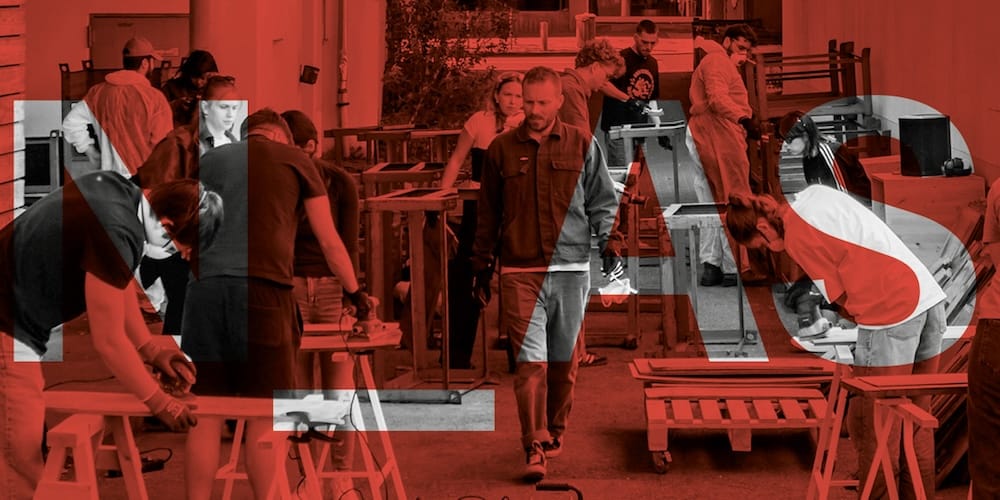
Many of the projects featured in the exhibition are characterised by the fact that the completed building is preceded by an extensive participatory process. In joint workshops, planners work together with teaching staff, pupils and parents to develop the objectives for the future building or the surrounding open spaces. Participation and identity are of great importance in this context. Against this backdrop, the exhibition also explores the added value of participation in school building planning.
More News
GROßER BDA-PREIS 2026
Auszeichnung würdigt André Kempe und den verstorbenen…
Im Modus der Serie
Differenz, Variation und Wiederholung in Architektur und…
Interplay – Planning and Building in Transition
Exhibition at Architekturgalerie München
N_AS / New Architecture School Siegen
Exhibition at the Architekturgalerie am Weißenhof