


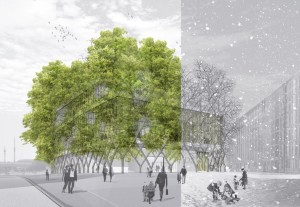
OLA – Office for Living Architecture, "House of the Future" Competition, 2012, Perspective © OLA
Reitermann / Sassenroth, Chapel of Reconciliation, 1996–2000 © Reitermann / Sassenroth, Photo: Bruno Klomfar
Closer to Nature – Building with Mushrooms, Trees and Clay
Exhibition at the Berlinische Galerie through October 14
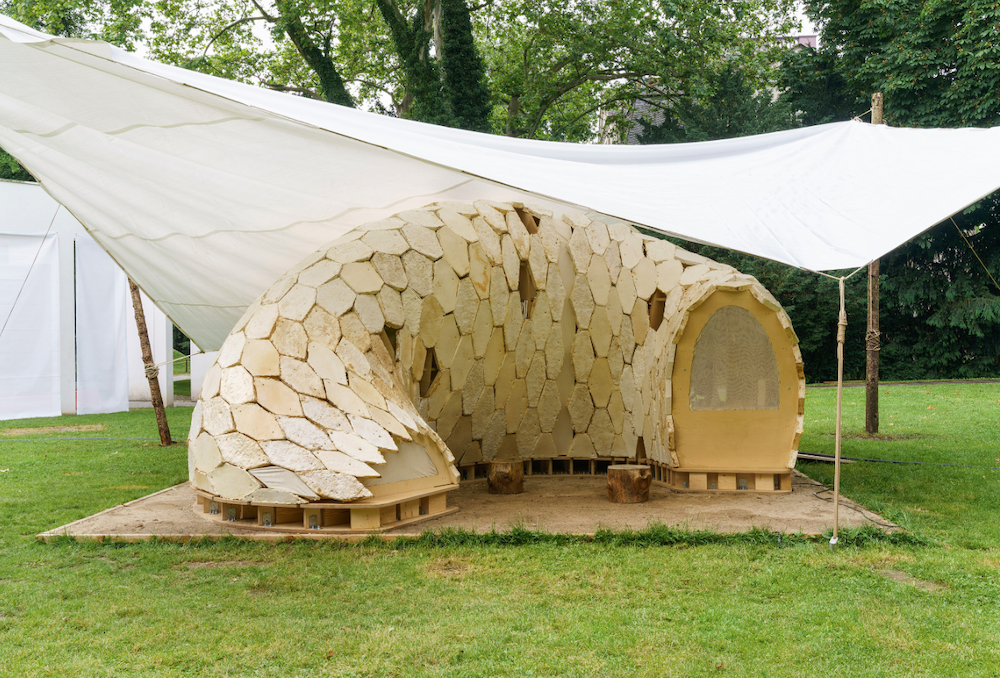
Architecture and nature have long operated in tension with one another. Faced with finite resources and ever-growing spatial demands, this relationship becomes a genuine dilemma. Add to that the construction industry's staggering output of waste and emissions, and a critical question emerges: what if we built with nature instead of against it? This exhibition showcases three Berlin-based architectural projects that explore this possibility: the experimental structure MY-CO SPACE (2021, MY-CO-X), a competition entry for the Futurium exhibition centre (2012, third prize, ludwig.schoenle, now OLA – Office for Living Architecture), and the Chapel of Reconciliation on Bernauer Strasse (1996–2000, Reitermann/Sassenroth Architekten with Lehm Ton Erde Baukunst – Martin Rauch).
Each harnesses the distinctive properties of fungi, living trees, and clay—creating structures that are not only ecologically sound but possess an entirely new character. These buildings breathe and grow, becoming living entities themselves. This vitality brings an unexpected sensuality to the architecture, crafting spatial experiences that let us physically feel our connection to the environment in ways that resonate far beyond the material. Throughout the exhibition, large-scale installations—many created specifically for this presentation—reveal the materiality and aesthetics of building with fungi, trees, and clay. Complementing these are some 45 original plans and sketches, photographs, renderings, objects, and models that trace the evolution of these three projects and the thinking behind them.
In fungal research, building botany, and contemporary clay construction, these featured collectives—Berlin's science-art collective MY-CO-X, Stuttgart's Office for Living Architecture (OLA), and Vorarlberg clay construction specialist Martin Rauch—are internationally recognised leaders or pioneers in their respective fields. What binds them together is their ability to bridge disciplines and eras: weaving cutting-edge technology with traditional craft practices, and perspectives from multiple fields into cohesive wholes.
Driven by the imperative to build climate-responsibly, they're forging new dialogues between architecture and the living world. Here, mushrooms, trees, and clay transcend their role as mere building materials—they become collaborators. Architects learn from them, and their properties actively shape both the conceptual vision and formal expression of the buildings. Through this approach, architecture and nature move toward one another, cooperating and ultimately merging into something entirely new.
More News
DAM Prize 2026
Shortlist Unveiled
PARS PRO TOTO
Exhibition of works by Nebel Pössl Architects

New, more comprehensive climate calculation
Troldtect A/S publishes ESG report

Sustainability Award for Architecture: Nominees announced
Five refurbishment and five new construction projects, including